Try, learn and adjust
Check audit independence and report accuracy
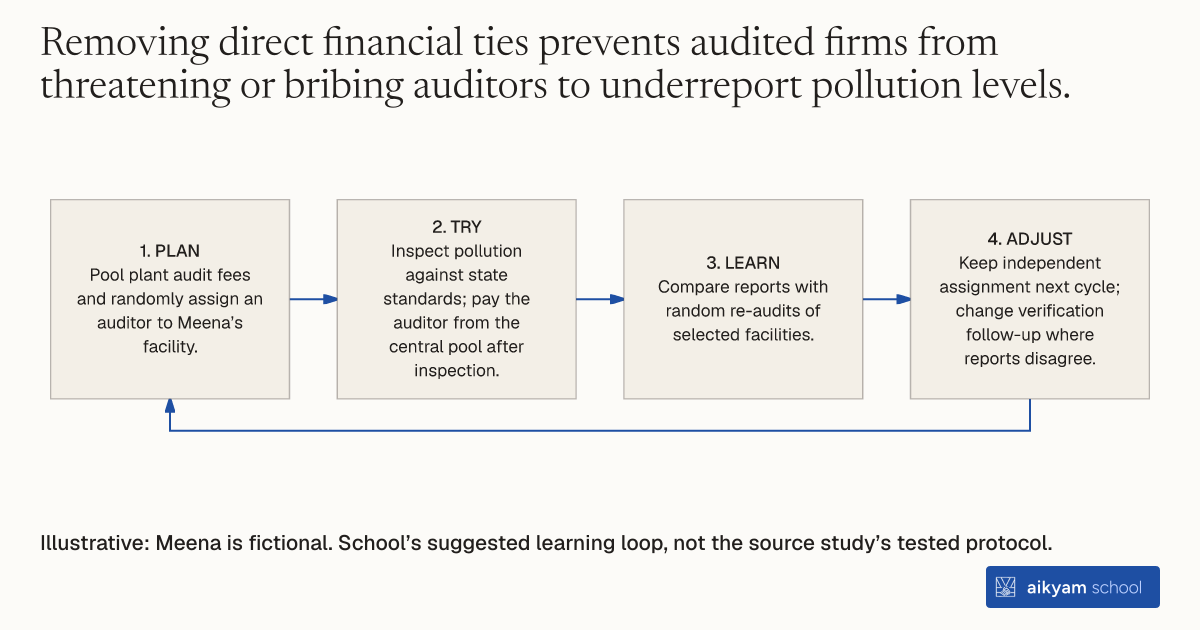
- Plan: Pool plant audit fees and randomly assign an auditor to Meena’s facility.
- Try: Inspect pollution against state standards; pay the auditor from the central pool after inspection.
- Learn: Compare reports with random re-audits of selected facilities.
- Adjust: Keep independent assignment next cycle; change verification follow-up where reports disagree.
Illustrative: Meena is fictional. School’s suggested learning loop, not the source study’s tested protocol.
See source →Auditor assignment, central payment and re-audit discrepancies; no assumed truthful report. School’s suggested learning loop, not a source-tested cycle.
How
When to use
Industrial facilities underreport pollution levels when allowed to directly hire and pay their regulatory inspectors. This problem occurs in settings where environmental authorities rely on third-party auditors to monitor industrial emissions. This method applies to environmental regulatory agencies seeking accurate pollution reporting from manufacturing plants.
Reorganize environmental auditing systems to eliminate direct financial relationships between industrial plants and third-party auditors.
- The environmental authority collects auditing fees from industrial plants into a centralized payment pool.
- The environmental authority randomly assigns third-party auditors to industrial facilities for each inspection cycle.
- The assigned auditor inspects the industrial plant and measures pollution levels according to state standards.
- The environmental authority pays the auditor directly from the centralized pool after inspection completion.
- The environmental authority conducts random re-audits on a subset of facilities to verify reporting accuracy in Gujarat, India.
Why it works
Independent assignment aligns auditor incentives with truthful reporting, which compels industrial facilities to reduce emissions.
Example
In Gujarat, India, state regulators reformed the industrial pollution audit system by randomly assigning auditors to plants and paying them from a central pool, which made auditors report truthful pollution levels and caused targeted industrial plants to reduce pollution.
About the study
Participants
Industrial manufacturing plants and third-party auditing firms in Gujarat, India.
Study Design
Randomized controlled trial evaluating a pollution audit system reform that introduced independent auditor assignment and centralized payment pooling.
Results
Increasing auditor independence made auditors significantly more likely to report the truth about plant pollution levels, which led industrial plants to reduce overall pollution emissions.