Try, learn and adjust
Check whether programme assumptions hold locally
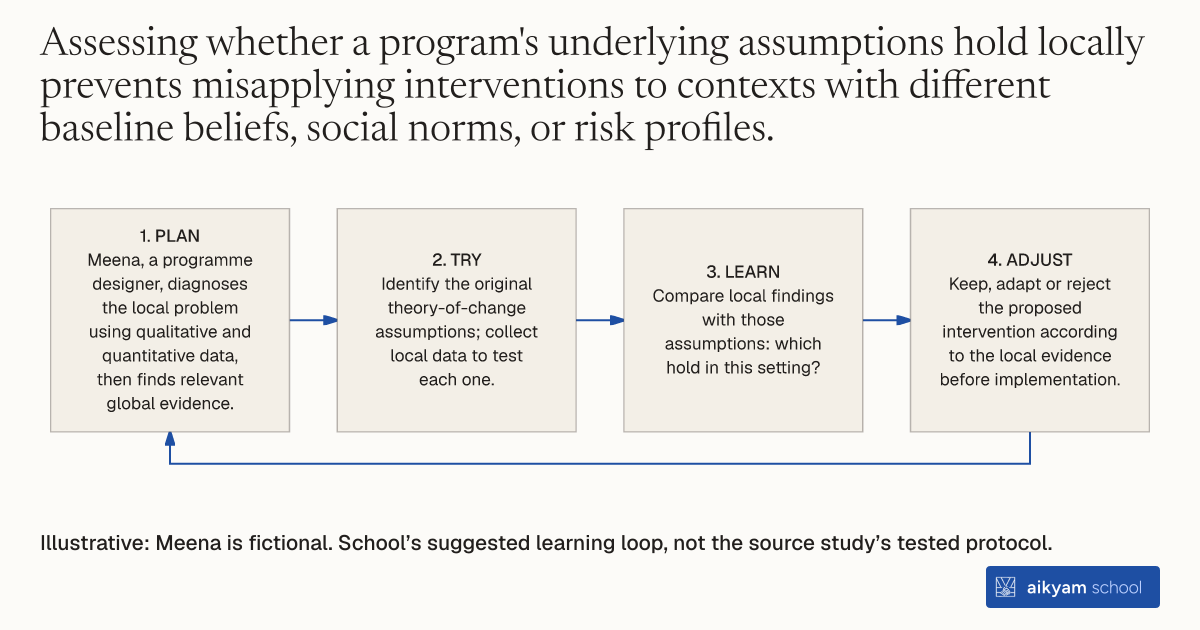
- Plan: Meena, a programme designer, diagnoses the local problem using qualitative and quantitative data, then finds relevant global evidence.
- Try: Identify the original theory-of-change assumptions; collect local data to test each one.
- Learn: Compare local findings with those assumptions: which hold in this setting?
- Adjust: Keep, adapt or reject the proposed intervention according to the local evidence before implementation.
Illustrative: Meena is fictional. School’s suggested learning loop, not the source study’s tested protocol.
See source →School’s suggested, untested learning loop. Observe local evidence for each assumption. This suggested learning loop does not establish transferability without assessment.
How
When to use
Policymakers considering implementing an intervention shown to work in another context need to determine whether the program will succeed in their own setting. Conducting a systematic diagnostic assessment avoids blindly copying programs or ignoring global evidence. This approach targets government officials and program designers adapting global health or social protection interventions locally.
Diagnose the local context and evaluate the original program's theory of change to decide whether an evidence-based intervention will work locally.
- Program designers diagnose the local problem using local qualitative and quantitative descriptive data.
- Program designers search for rigorous global evidence from other contexts that sought to solve a similar problem.
- Program designers identify the core assumptions underlying the original program's theory of change.
- Program designers collect local descriptive data to test whether each assumption in the theory of change holds in the target context.
- Program designers assess local findings against the theory of change before deciding whether to implement, adapt, or reject the intervention.
Why it works
Using local and global evidence as complementary inputs ensures policy decisions align with actual local mechanisms.
Example
In 2013, Rwandan policymakers evaluated Kenya's HIV relative risk information program by collecting local descriptive data on adolescent risk perceptions; finding that Rwandan girls already understood and overestimated HIV risk among older men, policymakers chose not to introduce the program.