Try, learn and adjust
Check field days show crops and demonstrator experience
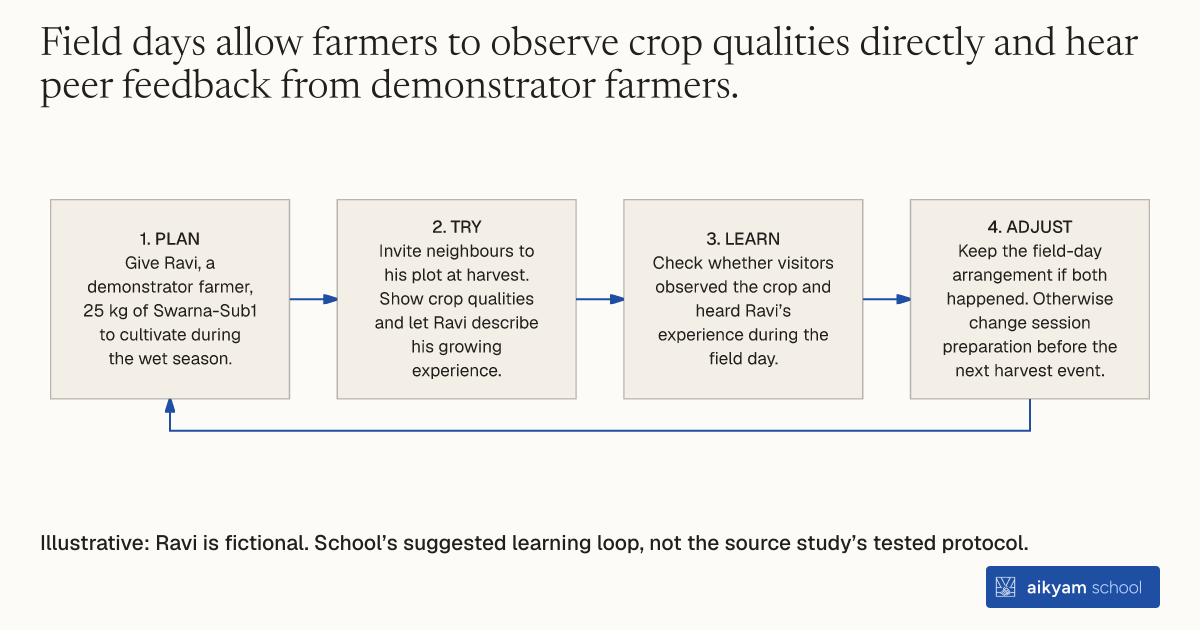
- Plan: Give Ravi, a demonstrator farmer, 25 kg of Swarna-Sub1 to cultivate during the wet season.
- Try: Invite neighbours to his plot at harvest. Show crop qualities and let Ravi describe his growing experience.
- Learn: Check whether visitors observed the crop and heard Ravi’s experience during the field day.
- Adjust: Keep the field-day arrangement if both happened. Otherwise change session preparation before the next harvest event.
Illustrative: Ravi is fictional. School’s suggested learning loop, not the source study’s tested protocol.
See source →School’s suggested learning loop: observe crop viewing and farmer discussion; do not infer later adoption from attendance.
How
When to use
Smallholder farmers often hesitate to adopt new agricultural technologies because crop performance cannot be directly observed prior to purchasing. Farmer field days allow villagers to learn about new seed varieties by observing crop performance on local demonstration plots. This helps smallholders make informed decisions and accelerates technology adoption.
Organize community field days on demonstrator plots during harvest time to show seed performance directly to neighboring farmers.
- Program managers allocate 25 kg seed packages of Swarna-Sub1 to demonstrator farmers in designated villages.
- Demonstrator farmers cultivate the seeds on their local agricultural plots during the wet season.
- Field staff invite neighboring farmers in target villages to attend field days held on the demonstrator plots at harvest time.
- Program staff host field day sessions on the plots where visiting farmers observe crop qualities and learn about the seed variety.
- Demonstrator farmers speak directly to visiting attendees to share their firsthand experiences growing the seed.
Why it works
Seeing crop performance on local plots reduces uncertainty and encourages farmers to adopt the variety.
Example
In 100 villages in Balasore district, Odisha, researchers evaluated holding farmer field days on demonstrator plots. In villages where field days took place, Swarna-Sub1 seed adoption reached 42 percent compared to 30 percent in control villages.
About the study
Participants
100 villages in Balasore district, Odisha, India.
Study Design
Randomized evaluation comparing Swarna-Sub1 seed adoption rates from direct sales between villages where farmers were invited to field days on demonstrator plots and control villages without field days.
Results
Farmers in villages where farmer field days took place were 12 percentage points more likely to adopt Swarna-Sub1 in the following season compared to those who did not participate (42 percent increase in adoption compared to 30 percent).