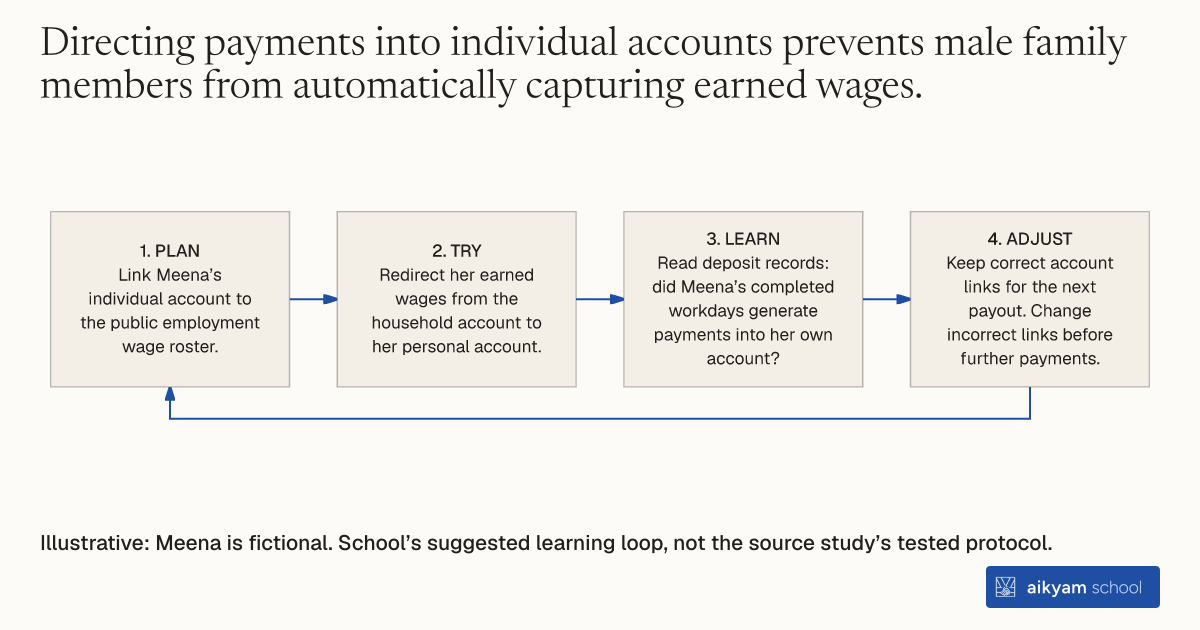
Try, learn and adjust
Check wages reach a woman’s own account
- Plan: Link Meena’s individual account to the public employment wage roster.
- Try: Redirect her earned wages from the household account to her personal account.
- Learn: Read deposit records: did Meena’s completed workdays generate payments into her own account?
- Adjust: Keep correct account links for the next payout. Change incorrect links before further payments.
Illustrative: Meena is fictional. School’s suggested learning loop, not the source study’s tested protocol.
See source →School’s suggested, untested loop. Observe wage deposits and destination accounts. Receipt alone does not establish financial autonomy.
How
When to use
Rural female workers often have public scheme wages paid into household accounts controlled by male relatives. Redirecting payments directly to women's individual accounts grants workers personal control over earned income. This method serves female public works participants in patriarchally structured rural communities.
Connect individual bank accounts of female workers to the public employment scheme payment system to redirect wage deposits.
- Identify female workers enrolled in public employment programs across targeted rural villages.
- Link each woman's personal bank account number directly to the government wage payment roster.
- Redirect wage payouts away from male-headed household accounts to individual female accounts.
- Issue automated bank transfer deposits whenever registered women complete program workdays.
Why it works
Having direct ownership of earnings gives women an incentive to seek paid work outside the home.
Example
In Madhya Pradesh, India, researchers partnered with state officials to link individual accounts of women to MGNREGS, ensuring wage payments went directly to female workers.
About the study
Participants
5,851 women in 197 gram panchayats across Gwalior, Morena, Shivpuri, and Sheopur districts in Madhya Pradesh, India.
Study Design
Randomized controlled trial across 197 village clusters evaluating bank account access, direct deposits, and training using baseline, 2015 short-run, and 2017 long-run surveys.
Results
Three years post-implementation, average total wage deposits reached US$66 among full treatment recipients, and assignment to direct deposit with training generated a 0.12 standard deviation increase in female banking autonomy.