Try, learn and adjust
Check rent assistance reaches the landlord
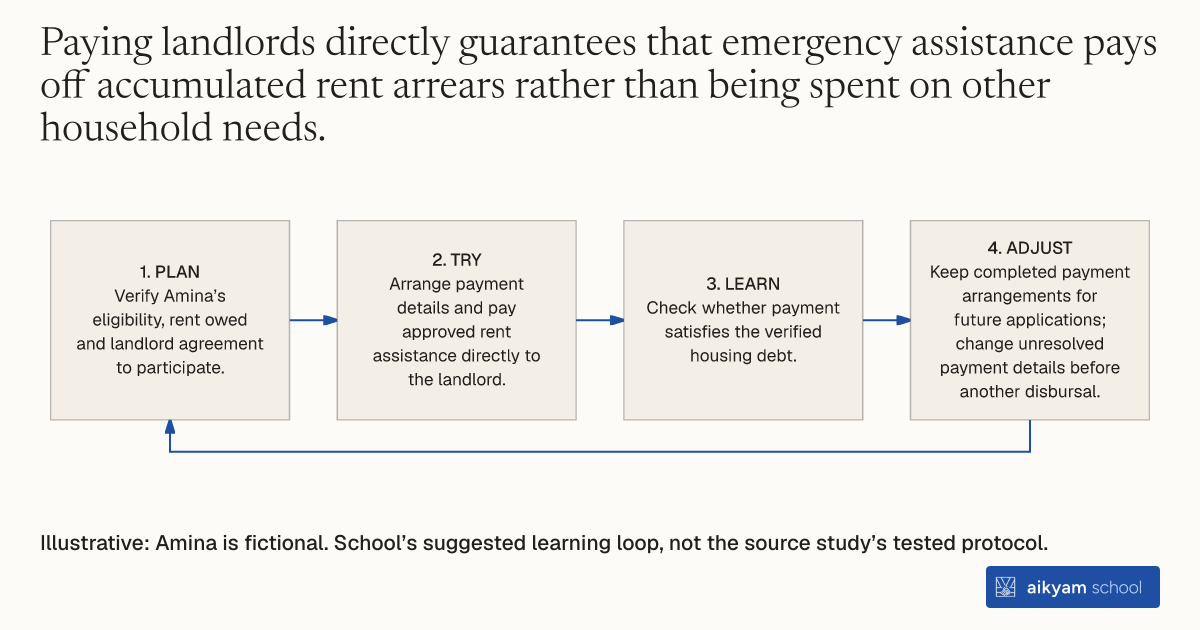
- Plan: Verify Amina’s eligibility, rent owed and landlord agreement to participate.
- Try: Arrange payment details and pay approved rent assistance directly to the landlord.
- Learn: Check whether payment satisfies the verified housing debt.
- Adjust: Keep completed payment arrangements for future applications; change unresolved payment details before another disbursal.
Illustrative: Amina is fictional. School’s suggested learning loop, not the source study’s tested protocol.
See source →School’s suggested learning loop: Observe verified rent debt, landlord participation and direct payment. Payment alone does not establish an eviction outcome.
How
When to use
Households face eviction due to past-due rent owed to housing providers. Direct payment provides emergency financial assistance straight to property managers or landlords on behalf of the tenant. This method ensures that approved funds directly resolve housing debt and satisfy landlord claims.
Issue emergency rental assistance payments directly to landlords, property owners, or property managers.
- Receive an application for emergency financial assistance from a tenant facing unpaid rent.
- Verify tenant eligibility and calculate the precise amount of rent owed to the housing provider.
- Require the third-party landlord or property manager to agree to participate in the assistance program.
- Arrange payment details between the administrative agency and the participating landlord or property manager.
- Disburse approved rental payments directly to the landlord or property manager to satisfy the housing debt.
Why it works
Landlords who receive full payment are less likely to initiate or pursue eviction proceedings against tenants.
Example
In Franklin County, Ohio, the Prevention, Retention, and Contingency program disburses approved rental assistance directly to landlords or property managers after third parties agree to participate.
About the study
Participants
Low-income families and renters facing eviction across U.S. cities, including Franklin County, Ohio and Philadelphia, Pennsylvania.
Study Design
Quasi-experimental evaluations and randomized controlled trials comparing households receiving emergency rental assistance against non-recipients.
Results
EFA recipients were up to 36% more likely to pay rent in full in the months shortly after receiving funds. EFA recipients were 88% less likely to become homeless after 3 months relative to those who did not receive EFA. Cost-effectiveness increased when programs targeted landlords who were most likely to pursue evictions.