Try, learn and adjust
Check emergency housing payments reach eligible renters
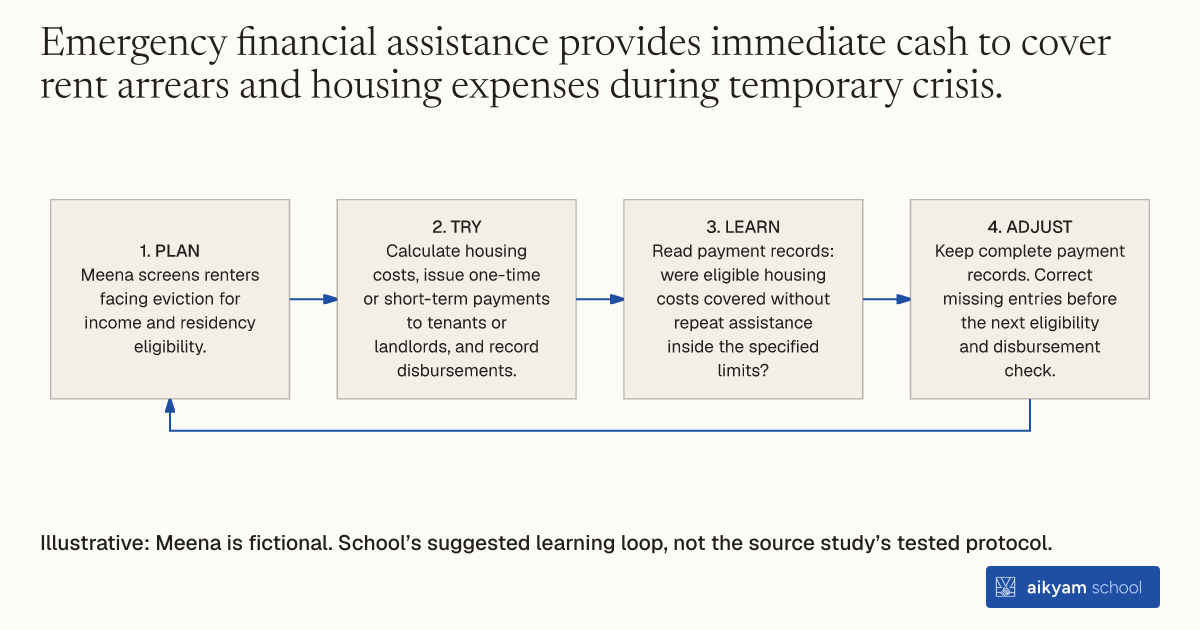
- Plan: Meena screens renters facing eviction for income and residency eligibility.
- Try: Calculate housing costs, issue one-time or short-term payments to tenants or landlords, and record disbursements.
- Learn: Read payment records: were eligible housing costs covered without repeat assistance inside the specified limits?
- Adjust: Keep complete payment records. Correct missing entries before the next eligibility and disbursement check.
Illustrative: Meena is fictional. School’s suggested learning loop, not the source study’s tested protocol.
See source →Observe eligibility, housing costs and payment records; do not infer housing stability from payment alone. School suggests this learning loop; it is not the source’s tested procedure.
How
When to use
Households experience sudden monetary shocks that leave them at risk of losing housing. One-time or short-term emergency financial assistance targets renters at high risk of eviction. This funding covers back rent, future rent, utility bills, or other housing costs to keep families stably housed.
Provide one-time or short-term cash payments to eligible households facing imminent eviction to cover housing costs.
- Identify renters who face high risk of eviction due to temporary financial hardship.
- Screen applicants to verify eligibility requirements such as income level and residency.
- Calculate the necessary cash payment required to cover back rent, upcoming rent, utility bills, or related housing costs.
- Issue one-time or short-term financial assistance payments directly to tenants or to their landlords on their behalf.
- Record disbursements to ensure households do not receive repeat assistance within specified time limits.
Why it works
Resolving immediate unpaid rent prevents eviction filings and averts episodes of homelessness.
Example
In Chicago, low-income applicants facing emergency financial crisis received short-term cash assistance through a call center to cover immediate rent and housing costs.
About the study
Participants
Low-income renters and families facing eviction across U.S. cities, including Chicago and Philadelphia.
Study Design
Randomized controlled trials and quasi-experimental evaluations comparing eligible applicants offered emergency financial assistance against non-recipients.
Results
Recipients were 88% less likely to become homeless after 3 months relative to non-recipients. Recipients were up to 36% more likely to pay rent in full in the months shortly after receiving funds. Studies estimated \$2.47 and \$1.99 of benefits per net dollar spent.