Procedure
Emergency assistance
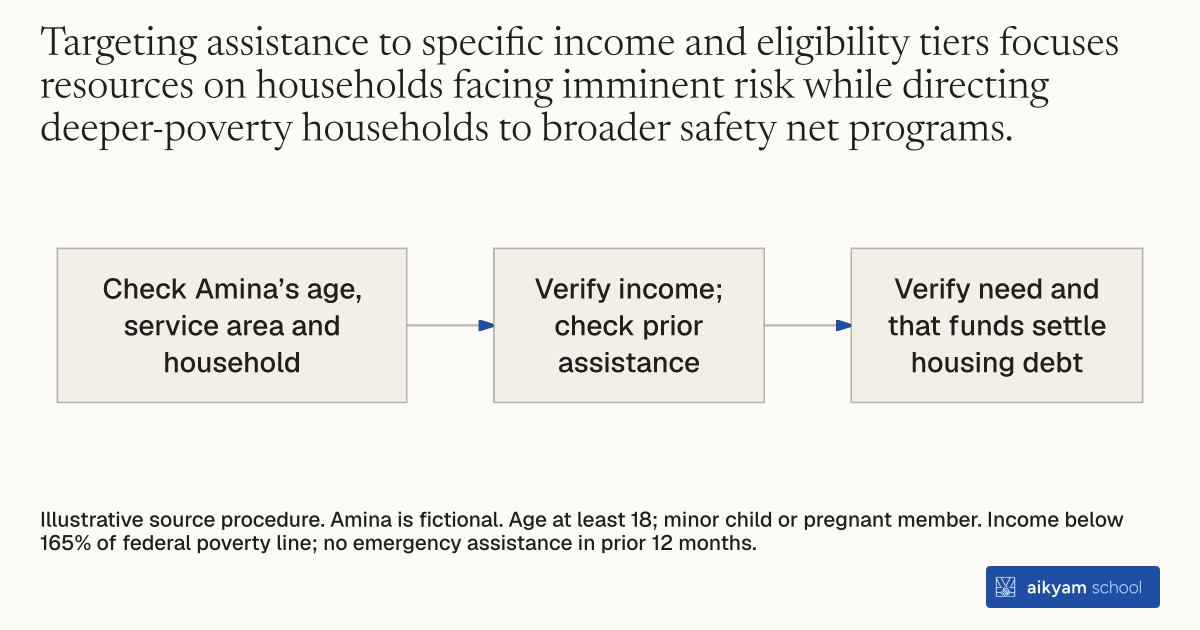
- Check Amina’s age, service area and household
- Verify income; check prior assistance
- Verify need and that funds settle housing debt
Illustrative source procedure. Amina is fictional. Age at least 18; minor child or pregnant member. Income below 165% of federal poverty line; no emergency assistance in prior 12 months.
See source →How
When to use
Low-income families face emergency financial crises that place them at risk of eviction. Eligibility screening establishes clear geographic, demographic, income, and need criteria to target assistance effectively. This ensures limited emergency funds reach qualified, high-risk households capable of maintaining housing stability.
Screen applicants for emergency financial assistance against defined eligibility criteria and verify demonstrated household need.
- Check that the applicant is at least 18 years old and resides within the designated program service area.
- Verify household composition to confirm the presence of at least one minor child or pregnant person.
- Review household financial documentation to ensure family income is below 165% of the federal poverty line.
- Confirm through program records that the household has not received one-time emergency assistance in the prior 12 months.
- Verify the household's financial need and confirm that disbursing funds will satisfy the emergency housing debt.
Why it works
Directing funds to very low-income families significantly increases programmatic cost-effectiveness.
Example
In Franklin County, Ohio, the Prevention, Retention, and Contingency program screens applicants to confirm age, residency, income below 165% of poverty line, family composition, 12-month receipt limits, and verified financial need.
About the study
Participants
Low-income families and renters facing eviction across U.S. cities, including Franklin County, Ohio.
Study Design
Quasi-experimental studies and randomized controlled trials evaluating targeted emergency financial assistance programs.
Results
Programmatic cost of averting an episode of homelessness was 35% lower for very low-income families than for the full sample. Cost effectiveness increases when programs target EFA to households most in need.