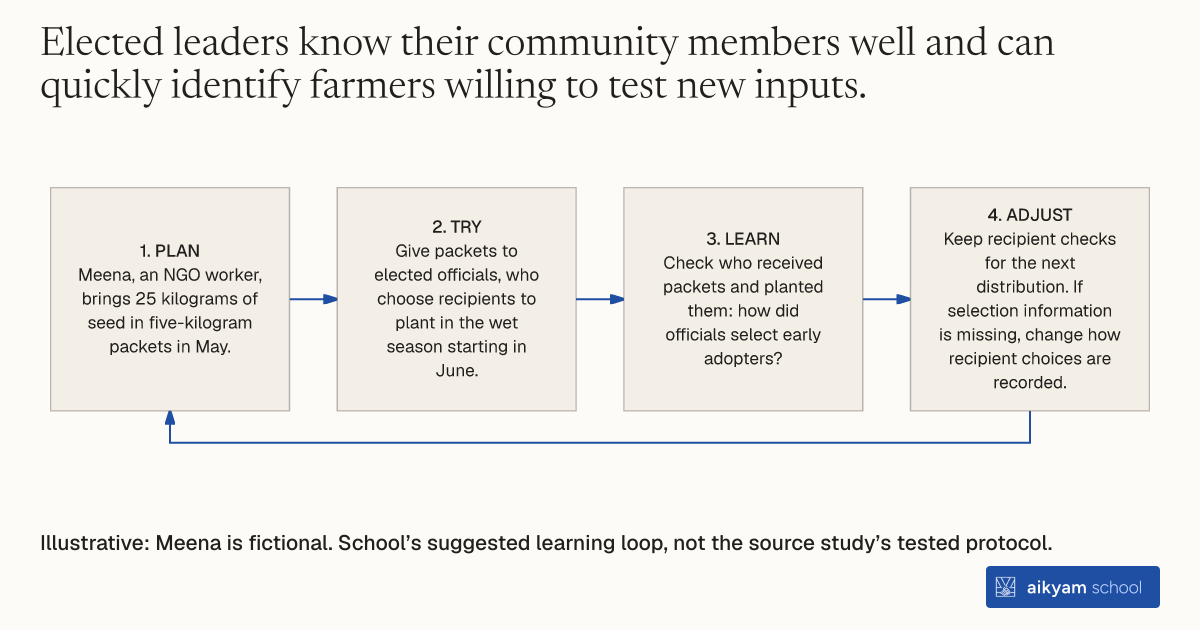
Try, learn and adjust
Check seed distribution through elected officials
- Plan: Meena, an NGO worker, brings 25 kilograms of seed in five-kilogram packets in May.
- Try: Give packets to elected officials, who choose recipients to plant in the wet season starting in June.
- Learn: Check who received packets and planted them: how did officials select early adopters?
- Adjust: Keep recipient checks for the next distribution. If selection information is missing, change how recipient choices are recorded.
Illustrative: Meena is fictional. School’s suggested learning loop, not the source study’s tested protocol.
See source →School’s suggested, untested learning loop. Observe recipient selection and planting; the evaluation found official favouritism, not superior later peer adoption.
How
When to use
Smallholder farmers in flood-prone areas lack information about new resilient crop varieties. Program managers need a direct channel through existing governance structures to distribute initial seed packages to local demonstrators. This method relies on locally-elected village leaders to select early adopters who test the new crop.
Distribute trial seed packages to locally-elected village officials and allow them to choose recipient farmers.
- NGO staff bring 25 kilograms of a new seed variety to each target village in May.
- NGO staff divide the seed into five-kilogram packets, providing enough seed to cultivate one to two acres.
- NGO staff hand over the seed packets directly to locally-elected village members.
- Locally-elected village members select which villagers receive the seed packets.
- Selected early adopters plant the seed packets during the wet season starting in June.
Why it works
While this approach risks leader favoritism, the chosen early adopters still serve as effective local demonstration plots for community learning.
Example
In 33 flood-prone villages in Odisha, India, NGO staff delivered five-kilogram packets of flood-tolerant Swarna-Sub1 rice seed to locally-elected village officials in May 2014. The officials chose which farmers received the packets to plant during the wet season. Although officials showed favoritism in picking recipients, downstream seed adoption by peers following field days matched the adoption rates of villages using participatory selection methods.
About the study
Participants
33 villages in Odisha, India; rice farmers where two-thirds lived below the US\$2.15/day poverty line and one-third belonged to scheduled castes.
Study Design
Randomized evaluation where 33 out of 100 villages were assigned to seed distribution through locally-elected officials.
Results
Local official distribution altered early adopter demographics through official favoritism, but peer seed adoption in the next planting season remained identical to participatory selection channels.