Research procedure
Track vouchers and household care seeking
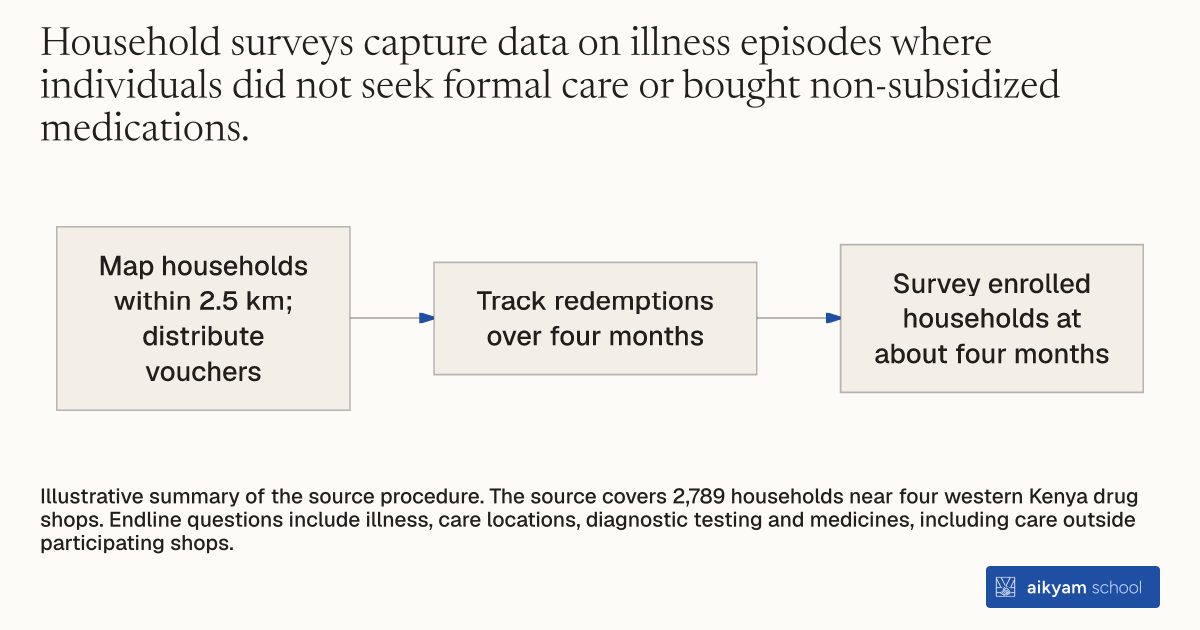
- Map households within 2.5 km; distribute vouchers
- Track redemptions over four months
- Survey enrolled households at about four months
Illustrative summary of the source procedure. The source covers 2,789 households near four western Kenya drug shops. Endline questions include illness, care locations, diagnostic testing and medicines, including care outside participating shops.
See source →How
When to use
Health interventions targeting retail healthcare access require evaluating household-level treatment behavior and health outcomes across varied socioeconomic groups. Relying solely on retail point-of-sale data misses people who chose not to seek care or who purchased medicine elsewhere. Distributing tracked discount vouchers to census-enumerated households and conducting a follow-up survey four months later captures total community health impact.
Distribute randomized discount vouchers to mapped households and conduct a comprehensive follow-up survey four months post-distribution.
- Map and enumerate all target households within two and a half kilometers of participating drug shops.
- Visit each enumerated household to distribute unique price subsidy vouchers for antimalarials or diagnostic tests.
- Monitor voucher redemptions at participating retail drug shops over a four-month intervention period.
- Re-visit all enrolled households four months after voucher distribution to conduct an endline survey.
- Record recent illness episodes, fever symptoms, health facility choices, diagnostic tests taken, and medications purchased.
Why it works
Combining voucher tracking with community-wide follow-up surveys provides a full picture of health-seeking shifts and treatment targeting across different income levels.
Example
In western Kenya, researchers mapped 2,789 households near four rural drug shops and distributed discount vouchers for ACTs and RDTs. Four months after distribution, researchers conducted an endline household survey gathering data on recent illness episodes, treatment locations, diagnostic tests taken, and drugs bought. The survey revealed that retail ACT subsidies reduced non-care seeking by 42 percent and increased drug shop treatment by 32 percent.
About the study
Participants
2,789 households residing near four rural drug shops in western Kenya, where 38 percent of household heads were illiterate.
Study Design
Randomized controlled trial conducted between May and December 2009. Researchers enumerated target households, distributed randomized price subsidy vouchers, tracked redemptions over four months, and administered an endline household survey approximately four months post-distribution to evaluate health-seeking behaviors and treatment uptake.
Results
The endline survey showed that retail subsidies reduced non-care seeking by 42 percent and increased retail drug shop care seeking by 32 percent. Subsidized ACT uptake among sick children in the poorest households rose from 15 percent in the comparison group to 44 percent in the subsidy group.