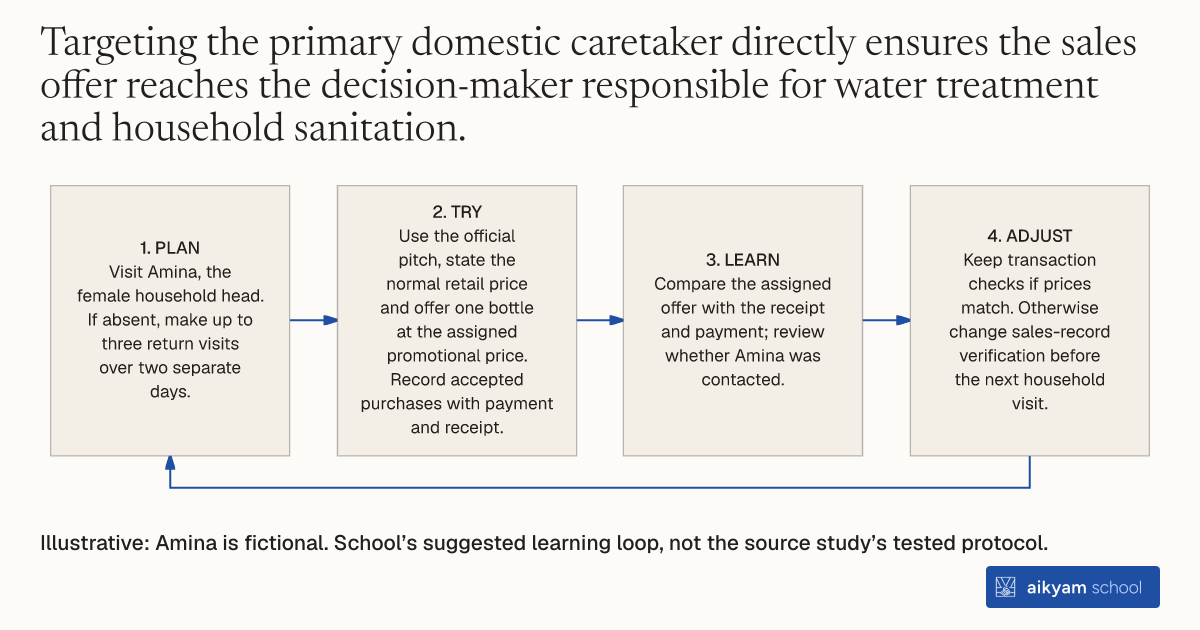
Try, learn and adjust
Check household sales follow the assigned offer
- Plan: Visit Amina, the female household head. If absent, make up to three return visits over two separate days.
- Try: Use the official pitch, state the normal retail price and offer one bottle at the assigned promotional price. Record accepted purchases with payment and receipt.
- Learn: Compare the assigned offer with the receipt and payment; review whether Amina was contacted.
- Adjust: Keep transaction checks if prices match. Otherwise change sales-record verification before the next household visit.
Illustrative: Amina is fictional. School’s suggested learning loop, not the source study’s tested protocol.
See source →School’s suggested learning loop: observe contact, offer prices and receipts; buying a health product does not establish its use.
How
When to use
Organizations seeking to market low-cost health products directly to households often face challenges with consumer adoption and price sensitivity. Standard retail channels may fail to reach target caretakers at home or explain product benefits effectively. This method provides a standardized direct-sales protocol for marketers delivering health products to households at fixed promotional prices.
Conduct standardized door-to-door sales visits targeting primary household caretakers with fixed promotional prices.
- A trained field marketer visits a sampled household during standard daytime hours and asks to speak directly with the female head of household.
- If the female head is absent, the marketer reschedules and makes up to three return visits on two separate days to reach her.
- The marketer introduces themselves as an official representative of the partner health organization and presents a standardized promotional pitch script.
- The marketer explicitly states that the health product normally retails for its standard market price in local stores.
- The marketer offers a single bottle of the product for a one-time promotional offer price specified on the household assignment sheet.
- If the consumer agrees to buy, the marketer completes the purchase transaction, collects payment, and writes a paper receipt.
Why it works
Explaining the higher standard retail price prevents consumers from inferring low product quality from promotional offer prices.
Example
Six marketers visited 1,260 sampled households across five periurban compounds in Lusaka, Zambia, successfully contacting 1,004 female heads of household. Marketers offered bottles of Clorin disinfectant at promotional offer prices ranging from 300 to 800 Zambian kwacha while emphasizing the 800 kwacha standard retail price, resulting in purchase acceptance by 61 percent of contacted households.
About the study
Participants
1,260 female heads of household in five low-income periurban compounds in Lusaka, Zambia.
Study Design
Randomized door-to-door direct marketing experiment where six trained marketers followed a written script offering a single bottle of Clorin at randomized promotional offer prices (300 to 800 kwacha), with up to three follow-up contact attempts per household.
Results
Direct marketing reached 1,004 of the 1,260 target households (80 percent contact rate). Overall purchase acceptance across all offer prices was 61.2 percent (614 households), declining from 84 percent at 300 kwacha to 48 percent at 800 kwacha.