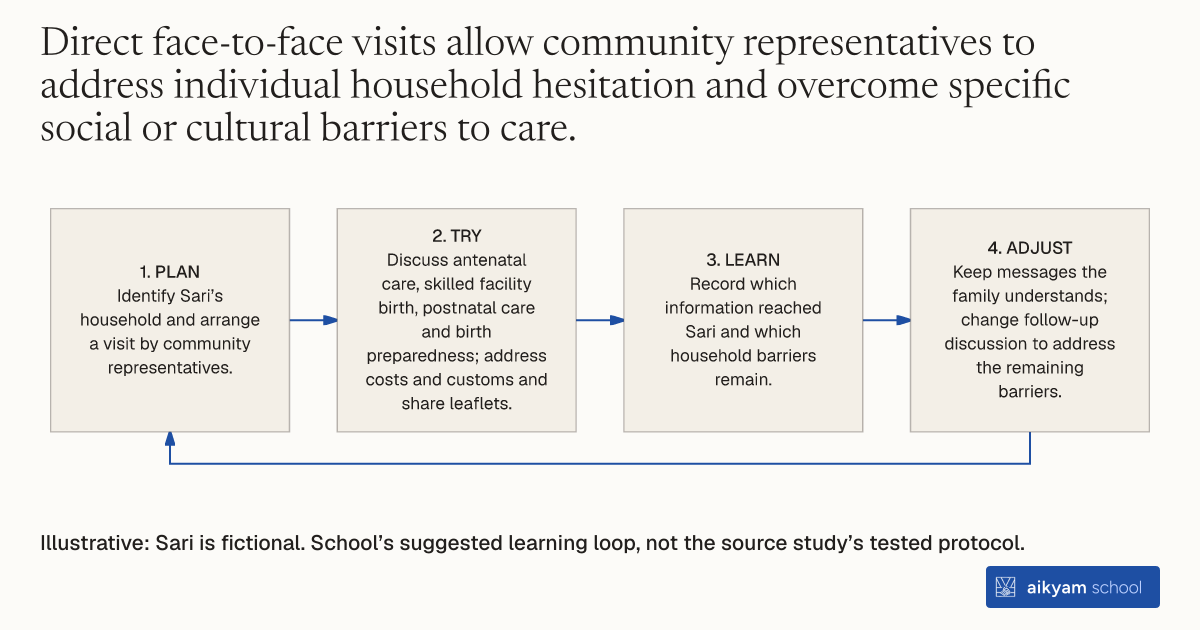
Try, learn and adjust
Check household visits address barriers to care
- Plan: Identify Sari’s household and arrange a visit by community representatives.
- Try: Discuss antenatal care, skilled facility birth, postnatal care and birth preparedness; address costs and customs and share leaflets.
- Learn: Record which information reached Sari and which household barriers remain.
- Adjust: Keep messages the family understands; change follow-up discussion to address the remaining barriers.
Illustrative: Sari is fictional. School’s suggested learning loop, not the source study’s tested protocol.
See source →Observe visits, information received and identified barriers; reported education completion does not establish service uptake. School suggests this learning loop; it was not tested by the source.
How
When to use
Rural expectant mothers and families lack awareness of essential maternal and newborn health services or hold attitudes that hinder timely care. Local community organizers need a direct outreach strategy to inform households about health service benefits. Organizers run this method to increase service uptake across antenatal care, facility delivery, and postnatal care.
Conduct a direct household education campaign to inform pregnant women and families about maternal health services.
- Recruited community representatives identify pregnant women and expectant families across village sub-districts.
- Form pairs or small teams of community representatives to visit identified households directly.
- Share educational information on the three health levers: antenatal care, facility birth with a skilled attendant, and postnatal care.
- Discuss birth preparedness plans, including saving money, arranging emergency transport, and identifying blood donors.
- Address specific family barriers such as service costs or cultural customs preventing facility visits.
- Distribute educational leaflets or posters reinforcing key maternal health messages throughout the community.
Why it works
Informing expectant mothers directly in their homes increases local awareness and builds confidence in facility-based maternal care.
Example
In rural treatment villages across Indonesia and Tanzania, community representatives conducted door-to-door visits and distributed leaflets to pregnant women, contributing to education actions planned in 93.5% of program villages and completing 82.9% of these education actions within 90 days.
About the study
Participants
200 rural villages across two regions in Indonesia and two regions in Tanzania, involving 15 to 16 community representatives per village.
Study Design
Randomized controlled trial evaluating a non-prescriptive social accountability program, collecting action plans and tracking the completion of community education activities across three monthly follow-up meetings.
Results
Participants in 93.5% of villages designed education actions focused on maternal health care uptake, with communities reporting an 82.9% completion rate for these awareness activities within 90 days.