Procedure
Household health visits
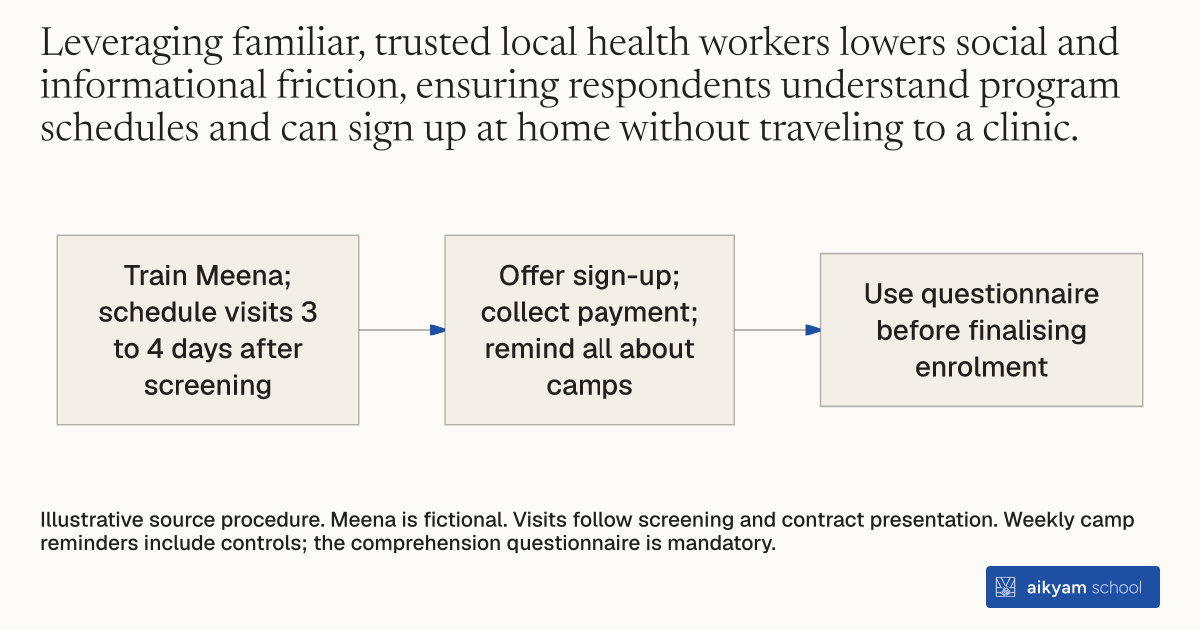
- Train Meena; schedule visits 3 to 4 days after screening
- Offer sign-up; collect payment; remind all about camps
- Use questionnaire before finalising enrolment
Illustrative source procedure. Meena is fictional. Visits follow screening and contract presentation. Weekly camp reminders include controls; the comprehension questionnaire is mandatory.
See source →How
When to use
Rural households often delay enrolling in preventive health programs or attending health camps due to inertia or lack of familiar local contact. Health providers need a trusted local outreach strategy to engage identified at-risk individuals directly in their homes. This method deploys community-based health workers for in-person household visits to answer questions, offer contract sign-ups, and encourage camp attendance.
Deploy local village health workers and coordinators to conduct follow-up door-to-door visits at participant households to discuss healthcare options and remind them of clinic schedules.
- Train village health workers and health coordinators who are already well-known in target communities for assessing local health needs.
- Schedule health workers to visit target households approximately 3 to 4 days after initial program screening and contract presentation.
- Health workers visit households that have not yet signed up for health options to ask if they wish to enroll and collect payments on the spot.
- Health workers visit all study households, including control participants, to provide reminders about upcoming weekly health camp schedules.
- Health workers guide interested respondents through a mandatory comprehension questionnaire before finalizing contract enrollment.
Example
In four rural villages in Punjab, India, village health workers and coordinators visited all 1,725 enrolled hypertensive and high-risk study households 3 to 4 days after baseline screening, providing camp reminders across all treatment arms and assisting interested respondents with contract sign-ups.
About the study
Participants
1,725 enrolled hypertensive and high-risk respondents across 4 rural villages in Punjab, India (59% female, average age 53.7 years).
Study Design
Field experiment implementation where Village Health Workers (VHW) and Health Coordinators (HC) visited all enrolled households 3 to 4 days post-baseline to offer contract enrollment and standardize camp reminders across control and treatment groups.
Results
Follow-up visits by health workers enabled participants to sign up at home, contributing to contract take-up rates ranging from 13.6% (fixed undiscounted) to 38.7% (personalized discounted) across 1,725 enrolled households.