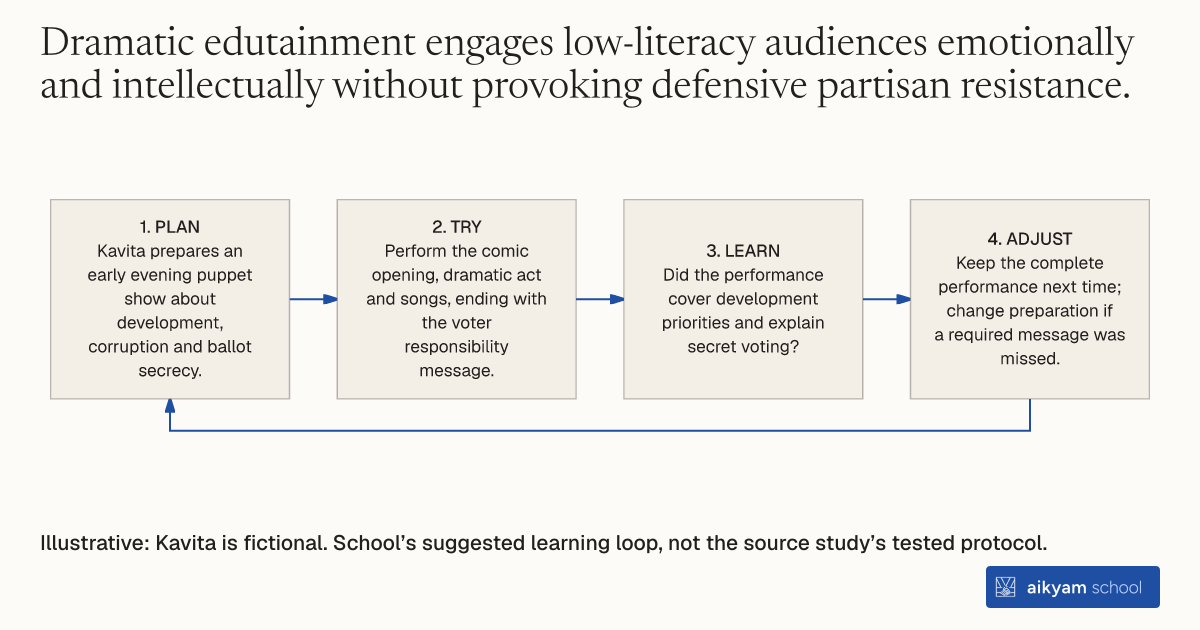
Try, learn and adjust
Check the puppet show delivers its messages
- Plan: Kavita prepares an early evening puppet show about development, corruption and ballot secrecy.
- Try: Perform the comic opening, dramatic act and songs, ending with the voter responsibility message.
- Learn: Did the performance cover development priorities and explain secret voting?
- Adjust: Keep the complete performance next time; change preparation if a required message was missed.
Illustrative: Kavita is fictional. School’s suggested learning loop, not the source study’s tested protocol.
See source →School’s suggested learning loop, not a tested source procedure. Observe message coverage and reported attendance; the study evaluated a campaign package, not the puppet show alone.
How
When to use
In rural developing communities with low literacy, formal lectures and print media often fail to engage voters on complex election concepts. An interactive street puppet show uses dramatic storytelling, comedy, and music to communicate non-partisan election principles to a broad audience. It provides an entertaining early evening platform to explain secret ballot mechanics and illustrate the community benefits of choosing development-oriented leaders over corrupt politicians.
Deploy trained puppeteers to perform an early evening street puppet show that delivers non-partisan voter education through dramatic entertainment.
- Set up the puppet stage in a central village area in the early evening as villagers return from daily work.
- Open the performance with a brief comic act to capture the audience's attention and introduce village development issues.
- Perform a main dramatic act depicting an honest challenger advocating for roads, electricity, and sanitation against a corrupt incumbent relying on bribes.
- Weave songs between scenes emphasizing that voters should elect leaders who fulfill infrastructure promises rather than make excuses.
- Highlight the secrecy of push-button electronic voting machines to reassure villagers that candidates cannot trace individual votes or retaliate.
- Conclude with a closing song restating that voters hold ultimate democratic responsibility for village outcomes.
Why it works
Depicting relatable village characters confronting corrupt local power brokers illustrates the benefits of development-focused voting while relieving fear of candidate retribution through explicit explanations of ballot secrecy.
Example
In central Uttar Pradesh, India, NGO field teams from Sarathi deployed trained puppeteers to conduct early evening puppet shows across treated villages in 36 polling-station clusters during the 2007 state assembly election. Exposure to puppet shows increased by 16.1 percentage points in treated villages (rising from 27% in control to 43.1% in treatment), contributing to a campaign that increased male voter turnout by 11 percentage points and reduced support for criminal caste-preferred candidates.
About the study
Participants
The trial evaluated 36 polling-station clusters across Lalitpur, Bahraich, and Sitapur districts in rural Uttar Pradesh, India, surveying 1,538 Hindu respondents (including Scheduled Castes and Other Backward Castes).
Study Design
Researchers evaluated the puppet show as part of a randomized cluster field experiment where NGO campaign teams performed evening dramatic shows, measuring exposure via a post-election private survey and analyzing voting outcomes using official Election Commission data.
Results
Survey data showed a 16.1 percentage point increase in reported puppet show attendance in treated villages (point estimate 0.161; p < 0.01) over a 27% control baseline, as part of an intervention that increased male turnout by 11 percentage points and reduced voting for caste-preferred candidates from 57.6% to 47.6%.