Try, learn and adjust
Check candidate debate invitations
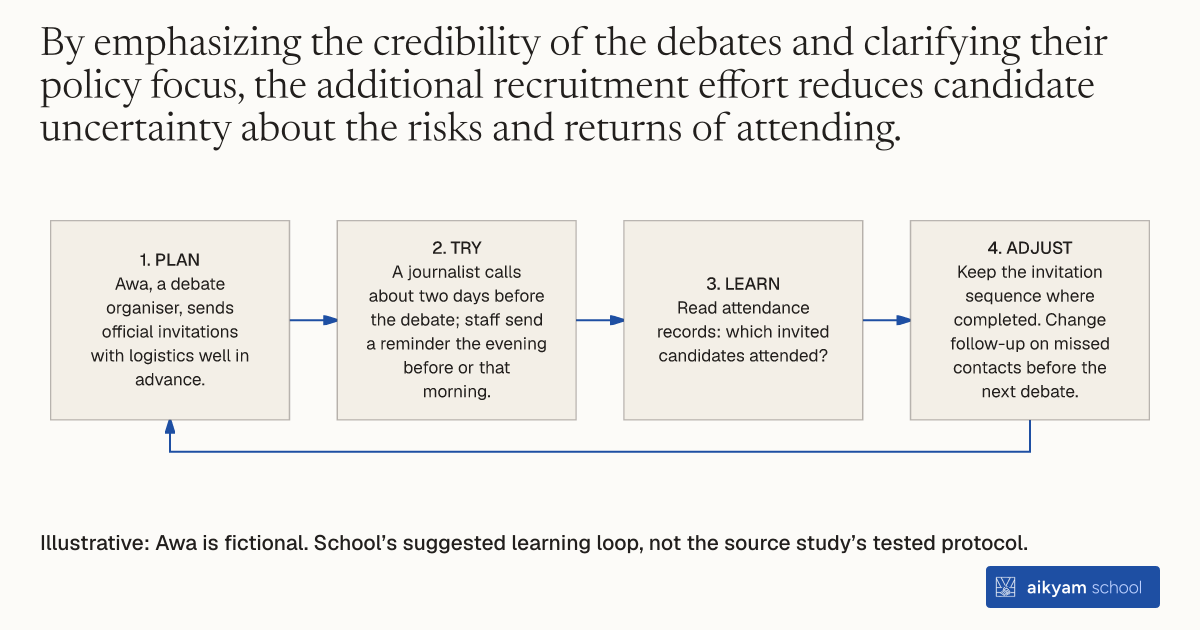
- Plan: Awa, a debate organiser, sends official invitations with logistics well in advance.
- Try: A journalist calls about two days before the debate; staff send a reminder the evening before or that morning.
- Learn: Read attendance records: which invited candidates attended?
- Adjust: Keep the invitation sequence where completed. Change follow-up on missed contacts before the next debate.
Illustrative: Awa is fictional. School’s suggested learning loop, not the source study’s tested protocol.
See source →School’s suggested learning loop: observe invitation contacts and attendance; this loop is separate from the tested invitation campaign.
How
When to use
Leading political candidates in clientelistic elections often refuse to attend public debates because they fear personal attacks, biased moderators, and losing strategic campaign flexibility. Organisers need to ensure high candidate attendance so citizens take part in electoral information programs. This approach persuades prominent politicians to participate in structured policy debates.
Persuade political candidates to participate in standardized public debates by implementing a three-part invitation campaign.
- Program managers send official branded invitation emails containing logistical details and contact instructions to all candidates as far in advance of the debate as possible.
- A high-profile radio journalist conducts phone calls to all candidates roughly two days before each debate to explain the unbiased policy structure and address candidate concerns.
- Program staff send text message reminders with location details to candidates on the evening before or the morning of the debate.
Why it works
Addressing fears about biased moderation and personal attacks encourages leading candidates to take part.
Example
Internews and USAID used this high-intensity invitation protocol across 38 randomized electoral districts in Liberia during the 2017 House of Representatives election. Candidate attendance rose significantly, with incumbent participation increasing by 21.2 percentage points to 50 percent and leading challenger participation rising by 21.2 percentage points to 60 percent.
About the study
Participants
73 electoral districts and 984 legislative candidates across Liberia ahead of the October 2017 legislative election.
Study Design
District-level randomized controlled trial comparing 38 high-intensity invitation districts to 35 standard-invitation control districts, with randomization stratified across 19 blocks based on organizer capacity and district covariates.
Results
Total candidate debate attendance increased by 7.7 percentage points from 54.2 percent in control to 61.9 percent in treated districts; incumbent attendance increased by 21.2 percentage points from 28.0 percent to 49.2 percent; challenger attendance increased by 21.2 percentage points from 49.2 percent to 70.4 percent.