Try, learn and adjust
Check the rally reaches village wards
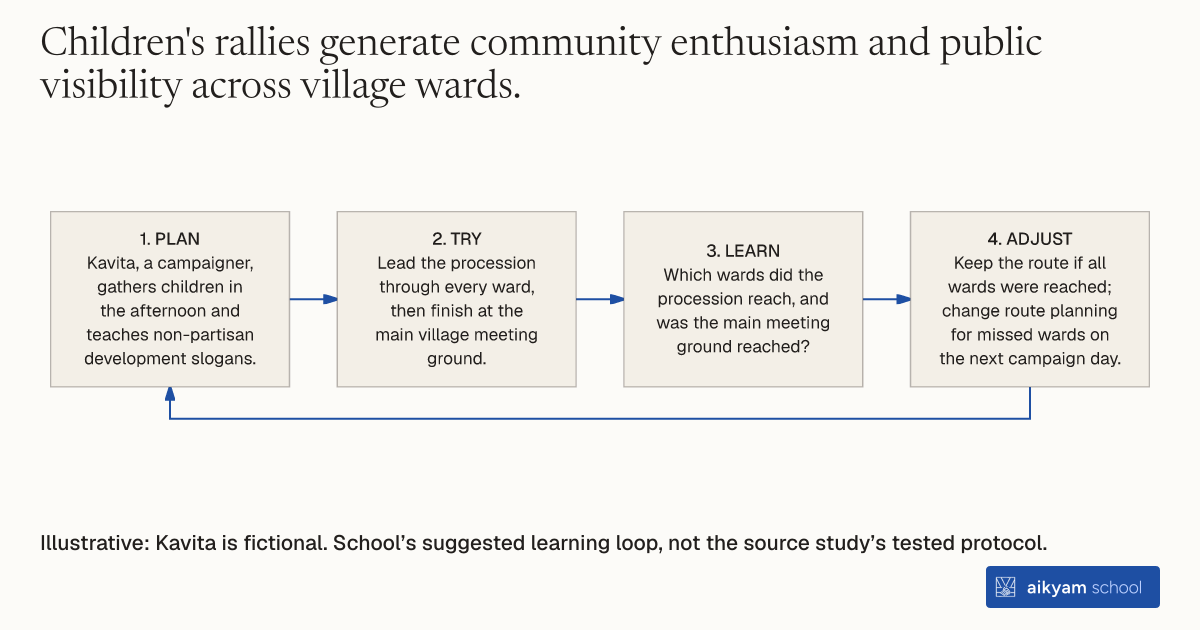
- Plan: Kavita, a campaigner, gathers children in the afternoon and teaches non-partisan development slogans.
- Try: Lead the procession through every ward, then finish at the main village meeting ground.
- Learn: Which wards did the procession reach, and was the main meeting ground reached?
- Adjust: Keep the route if all wards were reached; change route planning for missed wards on the next campaign day.
Illustrative: Kavita is fictional. School’s suggested learning loop, not the source study’s tested protocol.
See source →School’s suggested learning loop, not a tested source procedure. Observe ward coverage and the transition to the main meeting; the rally was part of a larger campaign.
How
When to use
In rural democratic elections, adult voters often remain disengaged or stuck in habitual caste-based voting patterns despite ongoing political campaigning. Organizing a children's rally leverages youth energy and community visibility to broadcast non-partisan civic messages throughout the village. This approach mobilizes public attention and creates an engaging, community-wide atmosphere for non-partisan electoral reform.
Organize an afternoon children's awareness rally to teach local children campaign messages and lead them on a march through the village.
- Field staff assemble village children in a central gathering area during the afternoon of the campaign day.
- Campaigners teach the children campaign slogans focused on development issues rather than caste loyalty.
- Line up the participating children to form a procession that marches through every ward of the village.
- Lead the children in chanting slogans loudly as they march to capture the attention of adult residents.
- Conclude the march at the main village meeting ground to transition into the evening campaign events.
Why it works
This draws the attention of adult residents to the campaign's non-partisan message before evening meetings.
Example
During the 2007 state assembly election in rural Uttar Pradesh, NGO field teams from Sarathi conducted afternoon children's rallies across treated villages in 36 polling-station clusters. While political parties also organized rallies, reported attendance at NGO children's rallies rose by 4.8 percentage points above the 2.4% control mean, contributing to a campaign that increased male turnout by 11% and reduced support for criminal caste-preferred candidates.
About the study
Participants
The trial evaluated 36 polling-station clusters across Lalitpur, Bahraich, and Sitapur districts in rural Uttar Pradesh, India, surveying 1,538 Hindu voters.
Study Design
Researchers evaluated the rally as part of a randomized cluster field experiment where two-person campaign teams executed a structured one-day intervention, measuring turnout via Election Commission rolls and activity attendance via a post-election survey.
Results
Survey data showed a 4.8 percentage point increase in reported attendance at NGO children's rallies (0.048; p > 0.1) over a control mean of 0.024, as part of an intervention that increased male turnout by 11 percentage points (raising male turnout from 60% to 67%) and reduced voting for caste-preferred candidates from 57.6% to 47.6%.