Research steps
Recruit eligible women before assignment
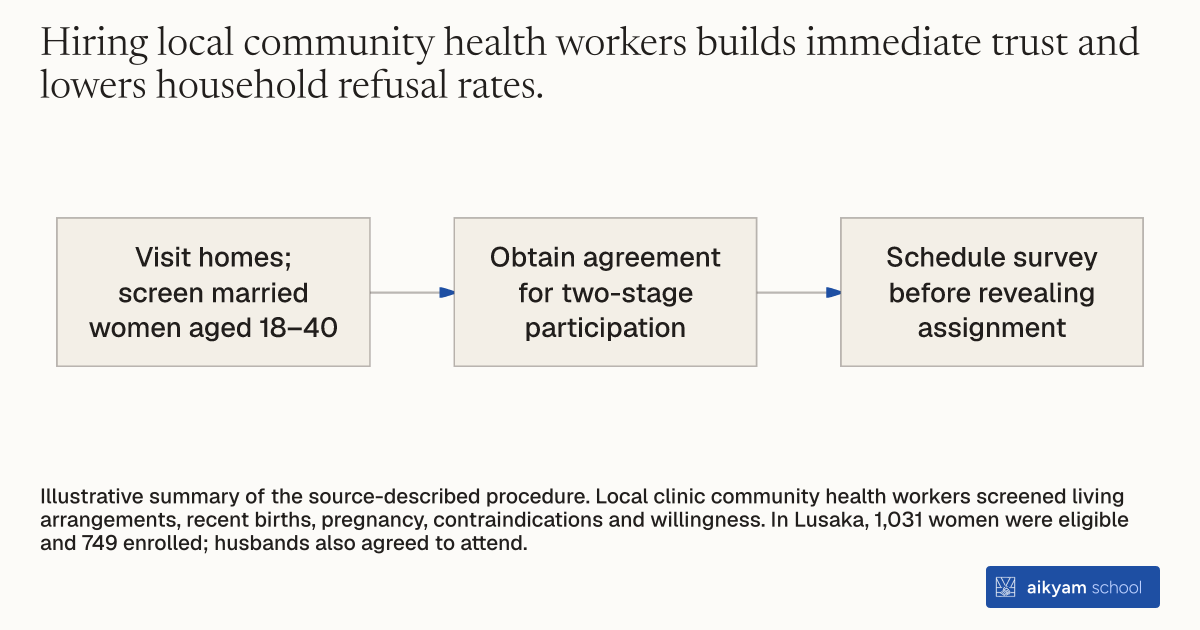
- Visit homes; screen married women aged 18–40
- Obtain agreement for two-stage participation
- Schedule survey before revealing assignment
Illustrative summary of the source-described procedure. Local clinic community health workers screened living arrangements, recent births, pregnancy, contraindications and willingness. In Lusaka, 1,031 women were eligible and 749 enrolled; husbands also agreed to attend.
See source →How
When to use
Field teams need to identify eligible study participants directly inside low-income neighborhoods. Household screening helps health projects reach target populations while maintaining balanced participation across study arms. This method allows researchers to locate married women who meet strict health and demographic criteria.
Screen and recruit married women through structured door-to-door household visits conducted by local health personnel.
- Hire community health workers from local clinics to visit homes in target catchment areas.
- Screen married women aged 18 to 40 using six criteria covering living arrangements, recent births, pregnancy status, medical contraindications, and willingness to participate.
- Obtain agreement from eligible women and their husbands to attend a two-stage survey and health information session.
- Schedule a second household visit for survey administration before revealing experimental group assignments.
Why it works
Applying identical screening requirements to all households before randomization prevents uneven dropout between trial arms.
Example
Community health workers in Lusaka, Zambia visited homes in the Chipata Clinic catchment area and identified 1,031 eligible married women aged 18 to 40 who had given birth between 2004 and 2006. Field teams successfully enrolled 749 married women and their husbands into the study across two experimental arms.
About the study
Participants
749 married women aged 18 to 40 and their husbands in Lusaka, Zambia.
Study Design
Two-stage randomized controlled trial using door-to-door household screening by clinic community health workers.
Results
Screening identified 1,031 eligible women and enrolled 749 participants, achieving balanced nonparticipation rates of 28.4 percent in the Couple arm and 26.2 percent in the Individual arm.