Research procedure
Schedule phone survey rounds
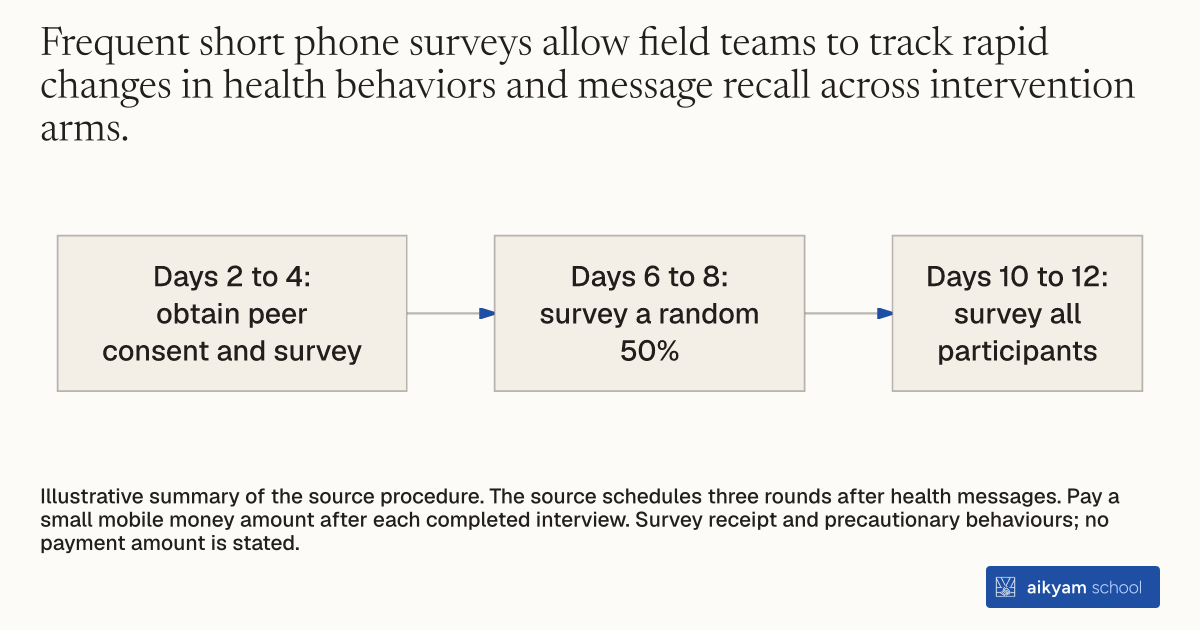
- Days 2 to 4: obtain peer consent and survey
- Days 6 to 8: survey a random 50%
- Days 10 to 12: survey all participants
Illustrative summary of the source procedure. The source schedules three rounds after health messages. Pay a small mobile money amount after each completed interview. Survey receipt and precautionary behaviours; no payment amount is stated.
See source →How
When to use
Public health interventions require continuous monitoring to evaluate whether outreach strategies increase message recall and protective behaviors. In-person follow-up surveys can be impossible or unsafe during an epidemic. Multi-round phone survey monitoring with mobile money payouts allows research teams to track message receipt and compliance across primary participants and their peers over time.
Administer structured follow-up phone surveys across multiple survey rounds following health text campaigns, compensating participants with mobile money upon survey completion.
- Assign baseline survey respondents and nominated peer contacts to survey follow-up schedules.
- Conduct survey round 1 on days 2 to 4 after the initial health message to obtain consent from peers and measure early message receipt and health precautions.
- Randomize 50 percent of primary participants and peer contacts to survey round 2 on days 6 to 8 after subsequent health messages to minimize survey fatigue.
- Conduct survey round 3 with all participants on days 10 to 12 following the third health message to record final outcomes across four precautionary behaviors.
- Transfer small mobile money payouts to participants immediately after each completed survey round to compensate them for their time.
Why it works
Immediate mobile money completion payouts maintain survey response rates and limit participant attrition over multiple interview rounds.
Example
In Zambia, field enumerators conducted up to three phone survey rounds with 3,027 primary participants and 8,779 nominated peer contacts, achieving a 62% contact rate among peer contacts in the reference group across survey rounds.
About the study
Participants
3,027 primary participants and 8,779 peer contacts in Zambia; primary participants were 45.7% female, 47.6% aged 20-29, 45.9% with secondary education, and 34.6% residing in Lusaka.
Study Design
Randomized phone follow-up surveys administered over three rounds (days 2-4, days 6-8 for a 50% subsample, and days 10-12) with small mobile money payouts after each completed interview.
Results
In survey round 3, control group outcome rates were 35% for frequent handwashing, 8% for wearing masks at gatherings, 38% for avoiding gatherings, and 80% for avoiding travel outside the village, with no statistically significant treatment effect on health behaviors across intervention arms.