Research procedure
Screen producers before export allocation
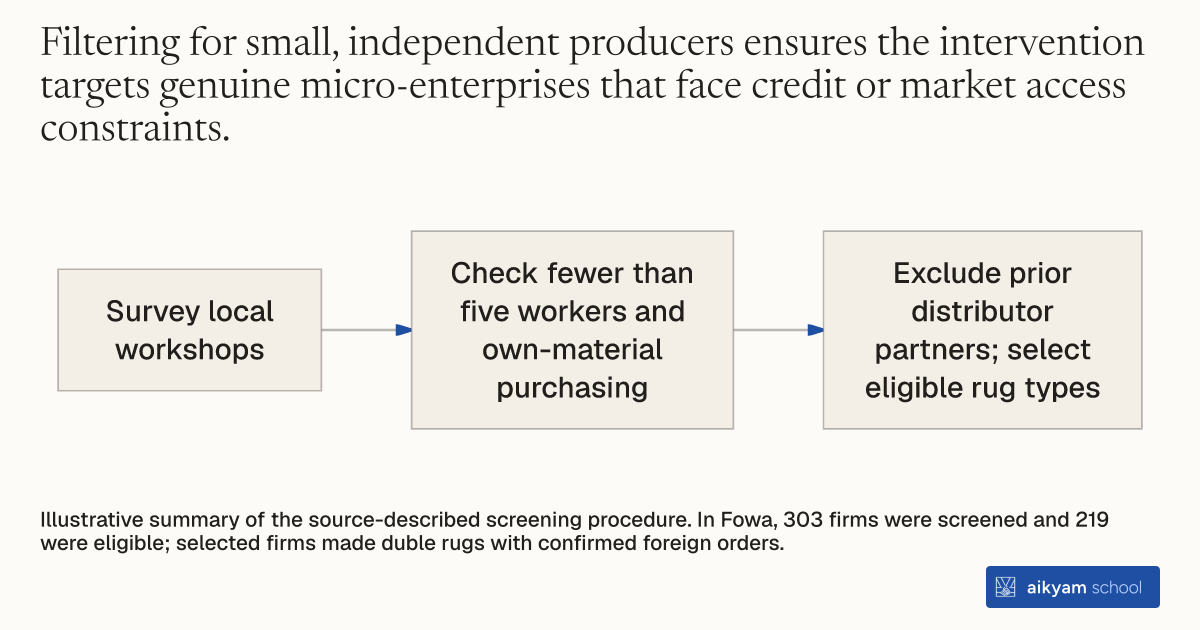
- Survey local workshops
- Check fewer than five workers and own-material purchasing
- Exclude prior distributor partners; select eligible rug types
Illustrative summary of the source-described screening procedure. In Fowa, 303 firms were screened and 219 were eligible; selected firms made duble rugs with confirmed foreign orders.
See source →How
When to use
Small-scale manufacturing programs often aim to target independent, local enterprises capable of fulfilling external orders. Without specific screening criteria, interventions risk including large firms, dependent subcontractors, or inexperienced producers. This approach establishes clear baseline eligibility thresholds to select viable micro-enterprises for export market access trials.
Screen local micro-enterprises through structured baseline surveys to identify qualified producers eligible for export market opportunities.
- Surveyors conduct a census of local manufacturing workshops in the target cluster.
- Surveyors verify that applicant firms employ fewer than five workers.
- Surveyors confirm that firm owners purchase their own production raw materials.
- Surveyors filter out firms with prior working relationships with the primary trade distributor.
- Surveyors focus selection on firms that produce rug types with confirmed foreign orders.
Why it works
Disqualifying firms with prior distributor ties isolates the true impact of introducing new export market linkages.
Example
In Fowa, Egypt, researchers screened 303 rug firms, identifying 219 eligible small producers that specialized in duble rugs, had under 5 employees, bought their own materials, and had never worked with Hamis Carpets.
About the study
Participants
N = 219 eligible small rug producers (74 treatment, 145 comparison) with fewer than 5 employees in Fowa, Egypt.
Study Design
Randomized Controlled Trial evaluating export opportunity allocation across 74 treatment and 145 comparison firms from 2011 to 2014.
Results
Eligible treatment firms offered export orders achieved a 26 percent increase in monthly profits and a 0.79 point higher quality score relative to comparison firms.