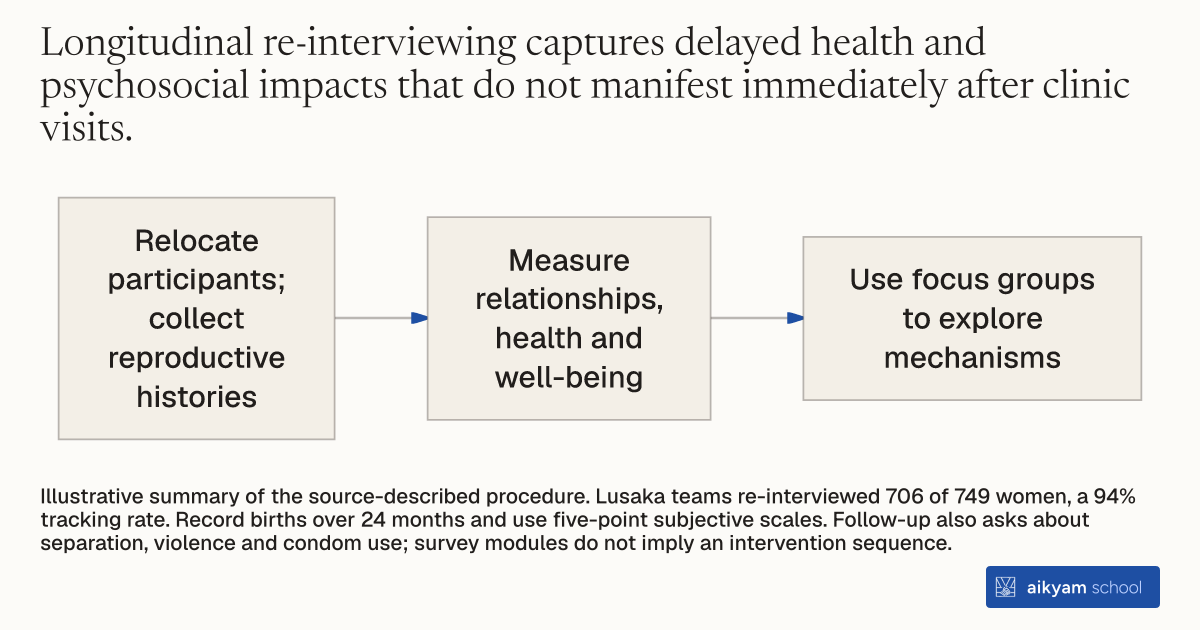
Research steps
Follow up women two years later
- Relocate participants; collect reproductive histories
- Measure relationships, health and well-being
- Use focus groups to explore mechanisms
Illustrative summary of the source-described procedure. Lusaka teams re-interviewed 706 of 749 women, a 94% tracking rate. Record births over 24 months and use five-point subjective scales. Follow-up also asks about separation, violence and condom use; survey modules do not imply an intervention sequence.
See source →How
When to use
Field teams need to evaluate the sustained long-run impacts of experimental health interventions on household welfare. Short-term tracking can miss delayed consequences like marital strain, emotional distress, or changing birth intervals. Conducting comprehensive household re-interviews two years post-intervention allows researchers to measure birth timing, relationship stability, and subjective health outcomes among married women.
Administer a structured longitudinal follow-up survey to enrolled women two years after baseline intervention.
- Deploy field survey teams to relocate participants in the Chipata Clinic catchment area two years post-baseline.
- Re-interview enrolled women using a structured questionnaire covering complete two-year reproductive histories, marital status, and partner relationships.
- Record exact birth dates and calculate inter-pregnancy intervals over the 24 months following initial voucher distribution.
- Measure subjective health, happiness, and life satisfaction using standardized five-point scale questions comparing respondents to peers.
- Survey women on physical domestic violence, spousal separation, and current condom usage across experimental arms.
- Conduct focus groups and qualitative debriefs with sub-samples of participants to analyze underlying mechanisms driving long-term outcomes.
Why it works
Standardized subjective well-being scales allow researchers to evaluate trade-offs between female reproductive autonomy and long-term conjugal harmony.
Example
Field teams in Lusaka, Zambia re-located and interviewed 706 of the 749 baseline enrolled women two years after initial voucher distribution. The follow-up survey revealed a 94 percent tracking success rate, establishing that private voucher access postponed short-term births by 3 to 5 months but reduced self-reported health and happiness among potential responder women.
About the study
Participants
706 married women aged 18 to 40 re-interviewed in Lusaka, Zambia.
Study Design
Two-year prospective longitudinal follow-up survey evaluating reproductive histories, subjective health, life satisfaction, marital dissolution, and domestic violence.
Results
Follow-up survey achieved a 94 percent re-interview rate (706 of 749 women), finding no significant effects on separation (7.6 percent overall) or domestic violence (26.8 percent overall), but showing that potential responder women in the private individual condition reported 22.4 percentage points lower good or excellent health (50.6 percent versus 73.0 percent, p < 0.05) and 15.1 percentage points lower happiness (54.0 percent versus 69.1 percent, p = 0.057) compared to the couple condition.