Research design
Score management practices
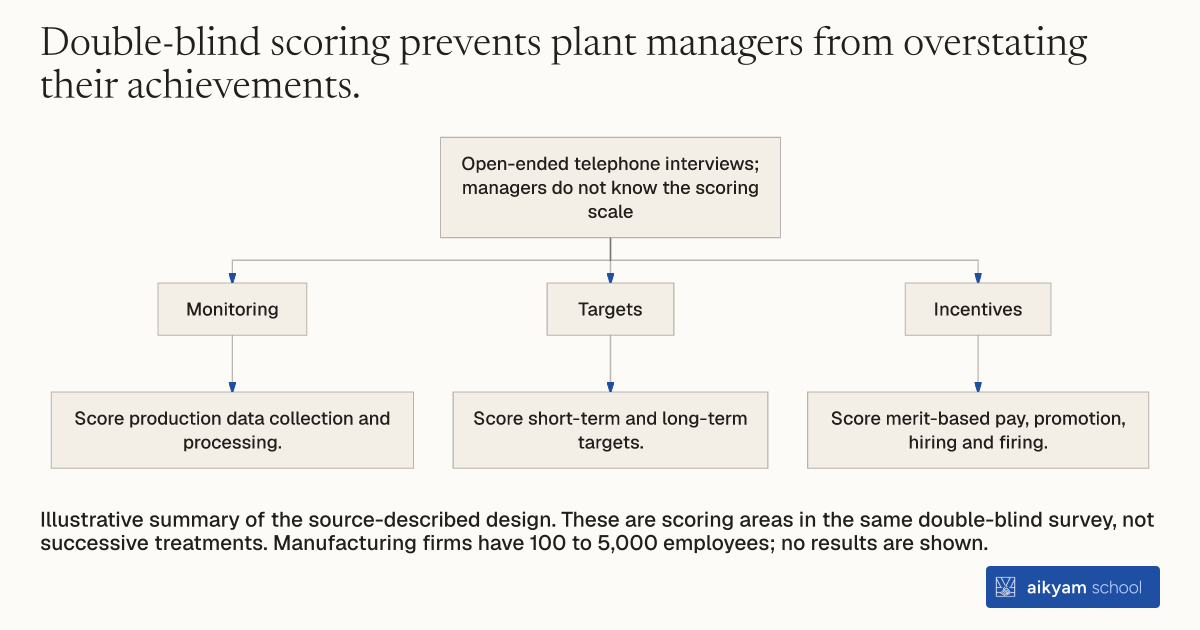
Open-ended telephone interviews; managers do not know the scoring scale
- Monitoring
- Score production data collection and processing.
- Targets
- Score short-term and long-term targets.
- Incentives
- Score merit-based pay, promotion, hiring and firing.
Illustrative summary of the source-described design. These are scoring areas in the same double-blind survey, not successive treatments. Manufacturing firms have 100 to 5,000 employees; no results are shown.
See source →How
When to use
Researchers and evaluators require an unbiased way to measure management quality across manufacturing plants. Self-reported manager evaluations fail because managers routinely overestimate their operational performance. This method measures management practices objectively across international enterprise samples.
Score plant management practices using double-blind survey procedures.
- Interviewers telephone plant managers in manufacturing firms with 100 to 5,000 employees without revealing the scoring scale.
- Plant managers answer open-ended questions about daily factory operations without knowing their answers are being scored.
- Interviewers evaluate monitoring practices by recording how factory staff collect and process production data.
- Interviewers evaluate target-setting practices by assessing whether plants set clear short-term and long-term targets.
- Interviewers evaluate incentive practices by recording whether promotion, pay, hiring, and firing depend on merit.
Why it works
It also stops interviewers from scoring firms based on prior knowledge of firm revenues.
Example
Researchers scored manufacturing firms with 100 to 5,000 employees across multiple countries using double-blind interviews. The survey revealed that firms in Brazil, China, and India have significantly lower average management scores than firms in the United States, Japan, and Western Europe.
About the study
Participants
Medium and large manufacturing firms with 100 to 5,000 employees across the United States, Japan, Western Europe, Brazil, China, and India.
Study Design
Cross-country double-blind survey evaluating 18 management practices categorized into monitoring, target setting, and incentives.
Results
Developing countries show significantly lower average management scores driven by a thick tail of badly managed firms that fail to improve or exit.