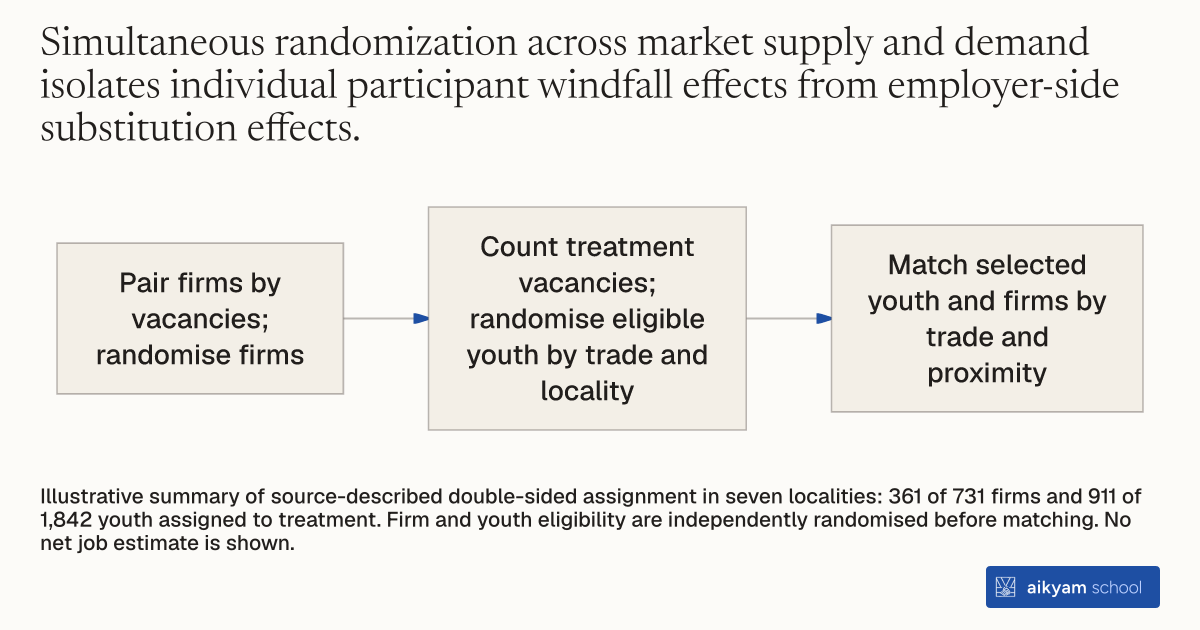
Research steps
Randomise both sides of apprenticeships
- Pair firms by vacancies; randomise firms
- Count treatment vacancies; randomise eligible youth by trade and locality
- Match selected youth and firms by trade and proximity
Illustrative summary of source-described double-sided assignment in seven localities: 361 of 731 firms and 911 of 1,842 youth assigned to treatment. Firm and youth eligibility are independently randomised before matching. No net job estimate is shown.
See source →How
When to use
Standard single-sided field experiments measure direct individual treatment effects but fail to detect market-level displacement or substitution. Evaluating net job creation requires simultaneously quantifying supply-side youth windfall participation and demand-side crowding-out in host firms. Randomizing program access on both market sides allows evaluators to isolate spillover mechanics and aggregate net employment gains.
Execute a double-sided randomized trial by independently assigning program eligibility across labor supply applicants and demand enterprise vacancies.
- Identify all participating microenterprises offering open training vacancies and group them into matched pairs based on their trade position structure.
- Randomize one enterprise in each pair to host subsidized apprentices while assigning the control enterprise to recruit through standard market channels.
- Count the total number of open training vacancies created across all selected treatment microenterprises within each specific trade and locality.
- Select an equal number of eligible youth applicants in each trade and locality, randomizing them between program placement and control status.
- Match selected treatment youth to treatment microenterprises based on residential proximity and stated trade preference.
Why it works
This joint structure allows researchers to establish rigorous bounds on net job creation without relying on unobserved market tightness assumptions.
Example
Researchers in Côte d'Ivoire implemented a double-sided randomized trial across 7 urban localities, assigning 361 of 731 microenterprises to host apprentices and 911 of 1,842 eligible youth to receive subsidized placements.
About the study
Participants
731 informal microenterprises and 1,842 eligible youth applicants aged 18 to 24 across 7 urban localities in Côte d'Ivoire.
Study Design
Stratified double-sided randomized trial pairing firms by trade vacancy portfolio and randomizing both firm vacancies and youth applicants.
Results
Double randomization identified a youth windfall parameter of 0.259 (p < 0.001) and a firm substitution parameter of 0.227 (p = 0.128), bounding net new apprenticeship position creation between 74.1 percent and 77.3 percent of formal placements.