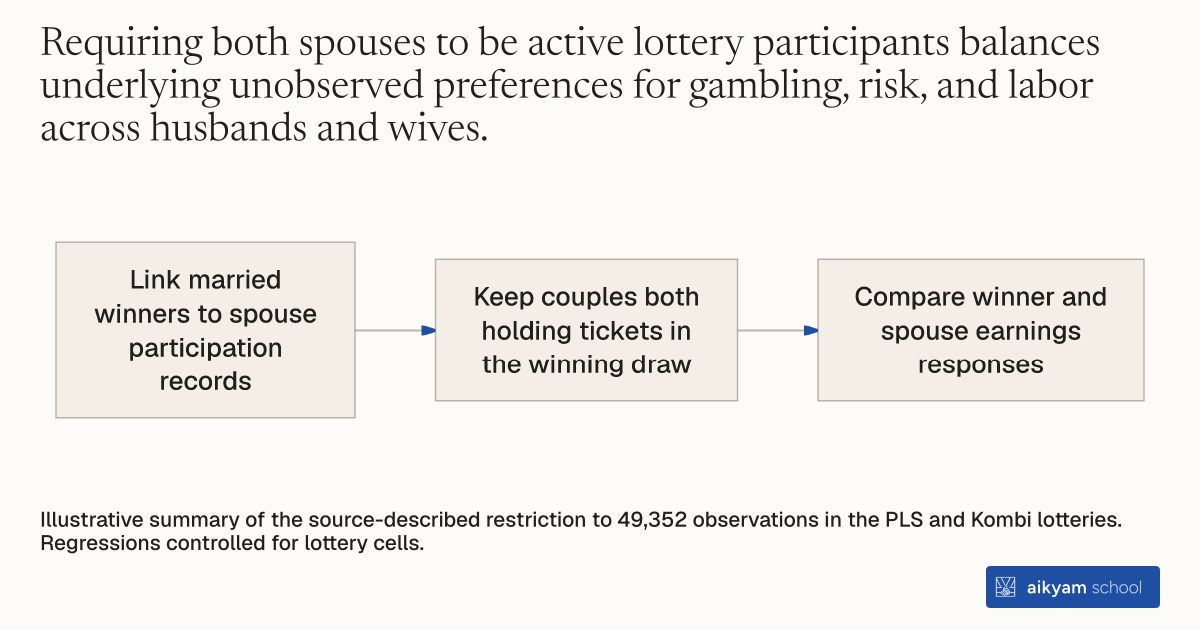
Research steps
Restrict bargaining tests to dual lottery participants
- Link married winners to spouse participation records
- Keep couples both holding tickets in the winning draw
- Compare winner and spouse earnings responses
Illustrative summary of the source-described restriction to 49,352 observations in the PLS and Kombi lotteries. Regressions controlled for lottery cells.
See source →How
When to use
Researchers need to eliminate selection bias when testing if spouses pool income in married households. Non-winning spouses may differ systematically from winning spouses in overall interest in playing lotteries or risk preferences. Restricting the married sample to couples where both spouses participated in the lottery removes selection differences between winners and spouses.
Restrict the analysis of married lottery winners to couples where both spouses actively bought lottery tickets in the draws under study.
- Match married lottery winners to national registry records to identify their spouses.
- Search lottery participation registers for the non-winning spouse using personal identification numbers.
- Identify couples where the non-winning spouse bought tickets in the winning draw or in previous draws.
- Filter the estimation sample to include only couples where both spouses participated in the winning draw.
- Estimate panel regressions on this restricted dual-participant sample comparing the labor supply reductions of winning spouses against non-winning spouses.
- Test whether the difference in labor supply reduction between winning and non-winning spouses remains statistically significant.
Why it works
This ensures that observed differences in labor reduction stem from individual income ownership rather than differences in player traits.
Example
In Sweden, researchers restricted the sample of married lottery players in the PLS and Kombi lotteries to 49,352 observations where both spouses held tickets in the winning draw, finding that winners reduced pre-tax labor earnings by 1.338 SEK per 100 SEK won more than their non-winning spouses.
About the study
Participants
49,352 observations of married Swedish couples aged 21 to 64 where both spouses participated in the winning draw of the PLS or Kombi lotteries.
Study Design
OLS panel regression on the restricted dual-participant married sample estimating five-year pre-tax labor earnings differences between winning and non-winning spouses while controlling for lottery cell fixed effects.
Results
In couples where both spouses played in the winning draw, winning spouses reduced annual pre-tax earnings by 1.338 SEK per 100 SEK won more than non-winning spouses (p = 0.035), with winners holding an average of 164.1 PLS tickets (or 1.34 Kombi tickets) compared to spouses holding 113.6 PLS tickets (or 1.20 Kombi tickets).