Try, learn and adjust
Check that household cost information is explained
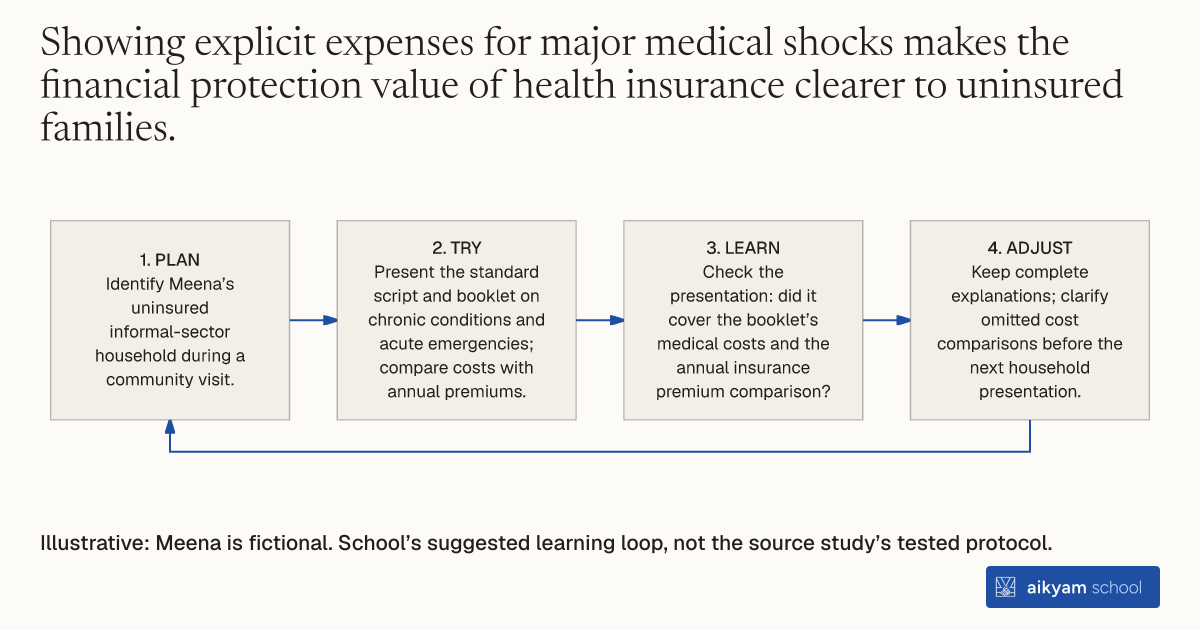
- Plan: Identify Meena’s uninsured informal-sector household during a community visit.
- Try: Present the standard script and booklet on chronic conditions and acute emergencies; compare costs with annual premiums.
- Learn: Check the presentation: did it cover the booklet’s medical costs and the annual insurance premium comparison?
- Adjust: Keep complete explanations; clarify omitted cost comparisons before the next household presentation.
Illustrative: Meena is fictional. School’s suggested learning loop, not the source study’s tested protocol.
See source →School’s suggested learning loop, not a tested protocol. Observe delivery of printed and oral cost information, not assumed insurance take-up.
How
When to use
Uninsured informal-sector households may underestimate the financial risk of major medical events and fail to enroll in public health insurance. Providing explicit information on health episode costs attempts to address information frictions and boost voluntary enrollment.
Deliver structured printed and oral educational materials detailing out-of-pocket medical costs during household visits.
- Identify target uninsured informal sector households during community survey visits.
- Develop a standardized script and an accompanying booklet detailing average out-of-pocket expenditures for common chronic health conditions.
- Include specific medical cost figures for acute health emergencies, such as treatment for a heart attack.
- Present the script and review the booklet directly with family members in their home.
- Compare prospective out-of-pocket health costs against annual insurance premiums to illustrate financial protection.
Example
Enumerators delivered an information script and booklet detailing heart attack and chronic disease treatment costs to uninsured informal households in Medan, Indonesia. The intervention changed Year 1 enrollment by a statistically insignificant 2.9 percentage points above the un-informed group baseline of 19.0 percent.
About the study
Participants
1,446 uninsured non-poor informal sector households in Medan, Indonesia.
Study Design
Randomized controlled trial comparing an extra information treatment detailing health episode costs against standard basic program information, evaluated via administrative data over 12 months.
Results
Year 1 enrollment increased by 2.9 percentage points (not statistically significant, standard error 0.029) off a baseline mean of 19.0 percent; effects larger than 8.5 percentage points are ruled out.