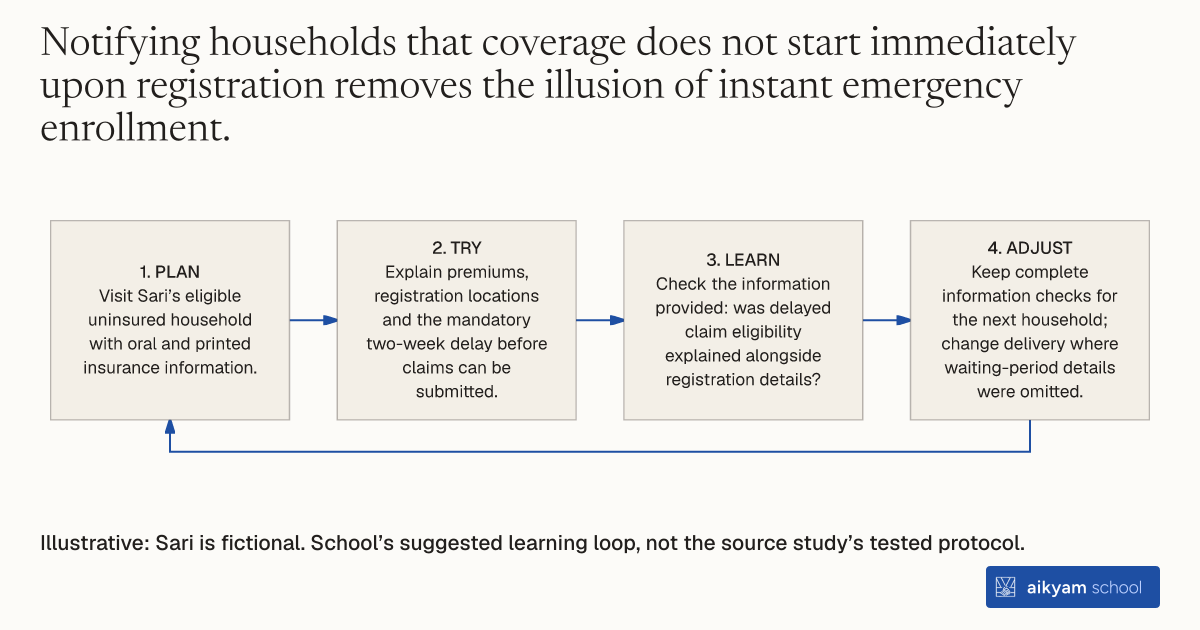
Try, learn and adjust
Check waiting-period information is explained
- Plan: Visit Sari’s eligible uninsured household with oral and printed insurance information.
- Try: Explain premiums, registration locations and the mandatory two-week delay before claims can be submitted.
- Learn: Check the information provided: was delayed claim eligibility explained alongside registration details?
- Adjust: Keep complete information checks for the next household; change delivery where waiting-period details were omitted.
Illustrative: Sari is fictional. School’s suggested learning loop, not the source study’s tested protocol.
See source →School’s suggested, untested learning loop. Observe the waiting-period explanation; the study’s 1.1 percentage point enrolment change was not statistically significant.
How
When to use
Uninsured informal-sector households may wait to sign up for public health insurance until an acute illness strikes. Governments introduce mandatory waiting periods after registration to prevent strategic enrollment timing when people get sick. Explicitly informing households about this mandatory delay aims to encourage early enrollment before health shocks occur.
Inform uninsured households about mandatory delays between insurance enrollment and claim eligibility to deter strategic delay.
- Target eligible uninsured informal-sector households during community visits.
- Provide basic oral and printed information explaining social health insurance coverage rules and monthly premium costs.
- Explain the mandatory two-week waiting period that delays claim submission after completing enrollment.
- Highlight that waiting until an illness happens prevents immediate access to insurance benefits.
- Provide registration location details and urge households to enroll before medical needs arise.
Why it works
This awareness encourages families to sign up while healthy rather than waiting for an illness.
Example
Enumerators informed uninsured informal households in Bandung, Indonesia about a new mandatory two-week waiting period between registration and claim eligibility. The treatment changed Year 1 enrollment by a statistically insignificant 1.1 percentage points above the un-informed baseline of 12.3 percent.
About the study
Participants
4,550 uninsured non-poor informal sector households in Bandung, Indonesia.
Study Design
Randomized controlled trial testing a waiting-period information intervention against a basic-information control group, evaluated via government administrative data over 12 months.
Results
Year 1 enrollment changed by 1.1 percentage points (not statistically significant, standard error 0.011) off a control baseline of 12.3 percent; positive effect sizes larger than 3.2 percentage points are ruled out.