Research groups
Compare household information scripts
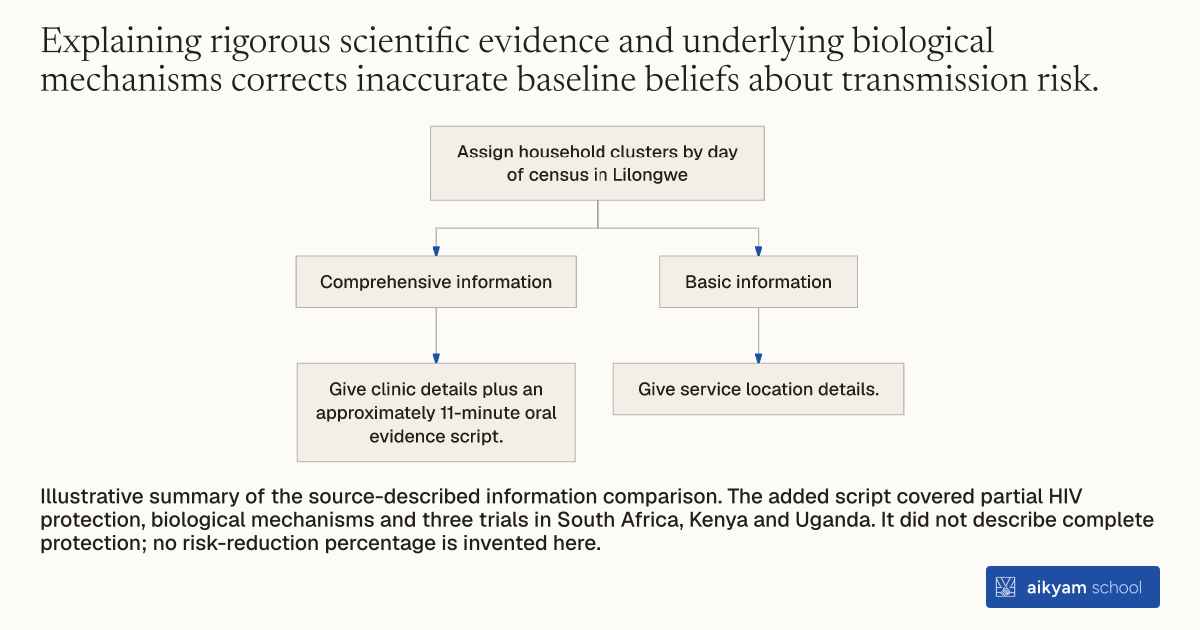
Assign household clusters by day of census in Lilongwe
- Comprehensive information
- Give clinic details plus an approximately 11-minute oral evidence script.
- Basic information
- Give service location details.
Illustrative summary of the source-described information comparison. The added script covered partial HIV protection, biological mechanisms and three trials in South Africa, Kenya and Uganda. It did not describe complete protection; no risk-reduction percentage is invented here.
See source →How
When to use
Low uptake of effective medical procedures often stems from a lack of accurate information regarding medical efficacy. Standard health campaigns may announce service availability without explaining the underlying scientific trial results that demonstrate health benefits. This method delivers structured, detailed oral information about landmark randomized controlled trials directly to target individuals during home visits.
Deliver a standardized 11-minute oral presentation explaining randomized controlled trial findings on male circumcision to target individuals during household visits.
- Assign household clusters by day of census to receive either comprehensive information or basic service location details.
- Visit eligible respondents in their homes as part of a baseline survey administration.
- State that medical male circumcision is partially protective against HIV transmission during sexual intercourse.
- Explain the key findings and percentage risk reductions from three randomized controlled trials conducted in South Africa, Kenya, and Uganda.
- Describe the biological mechanisms explaining why male circumcision provides partial protection against HIV transmission.
- Spend approximately 11 additional minutes delivering this structured script alongside standard clinic availability details.
Why it works
Increasing perceived risk reduction encourages individuals to re-evaluate health decision-making and increases willingness to undergo preventive medical procedures.
Example
In Lilongwe, Malawi, trained enumerators delivered an 11-minute oral information script on RCT evidence to uncircumcised men during baseline household visits. Receiving this comprehensive information increased actual clinic circumcision take-up by 1.4 percentage points and lowered perceived circumcised HIV transmission rates by 8.751 per 100 men.
About the study
Participants
1,634 uncircumcised men aged 18 to 35 residing in urban Lilongwe, Malawi.
Study Design
Individual household field experiment with information randomized at the day-of-census level, evaluating long-term clinic voucher redemptions and one-year panel survey belief updates.
Results
Information increased medical circumcision take-up by 1.4 percentage points and reduced perceived transmission rate for circumcised men by 8.751 per 100 men.