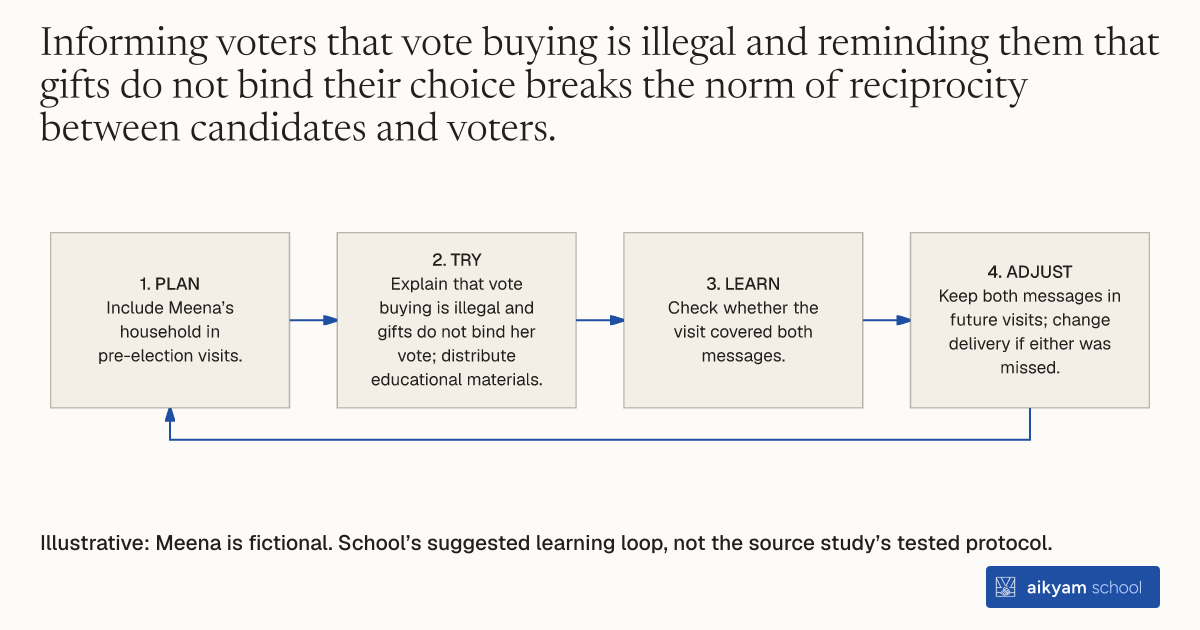
Try, learn and adjust
Check delivery of conscience-voting messages
- Plan: Include Meena’s household in pre-election visits.
- Try: Explain that vote buying is illegal and gifts do not bind her vote; distribute educational materials.
- Learn: Check whether the visit covered both messages.
- Adjust: Keep both messages in future visits; change delivery if either was missed.
Illustrative: Meena is fictional. School’s suggested learning loop, not the source study’s tested protocol.
See source →Household visits and message coverage; do not assume turnout will rise. School’s suggested learning loop, not a source-tested cycle.
How
When to use
Politicians buy votes with gifts or cash during elections, weakening democratic accountability. Voters accept gifts and feel obligated to support those candidates at the ballot box. This method helps electoral commissions reduce the impact of vote buying by urging voters to vote according to their conscience.
Conduct a door-to-door educational campaign that informs citizens that vote buying is illegal and encourages them to vote according to their conscience.
- Deploy campaigners to visit households across targeted electoral districts before an election.
- Distribute educational materials emphasizing that vote buying violates national election laws.
- Inform voters that receiving gifts or money from political candidates does not legally or morally bind their vote.
- Urge voters to vote their conscience freely regardless of whether they accept gifts from candidates.
- Track electoral outcomes and vote transactions across targeted districts to assess campaign effects.
Why it works
This reduces the ability of politicians to buy vote choices with financial offers.
Example
Ahead of the 2006 presidential election in São Tomé and Príncipe, the National Electoral Commission ran a door-to-door conscience campaign, which reduced the frequency and price of vote transactions, decreased voter turnout, and shifted vote share from the challenger to the incumbent.
About the study
Participants
Voters and households across São Tomé and Príncipe during the 2006 presidential election.
Study Design
Randomized field experiment assessing the impact of a door-to-door anti-vote-buying voter education campaign conducted by the National Electoral Commission.
Results
Reduced the frequency and price of vote transactions, decreased the influence of money offered on voting, decreased voter turnout, and shifted vote share from the challenger to the incumbent.