Try, learn and adjust
Check the village campaign reaches residents
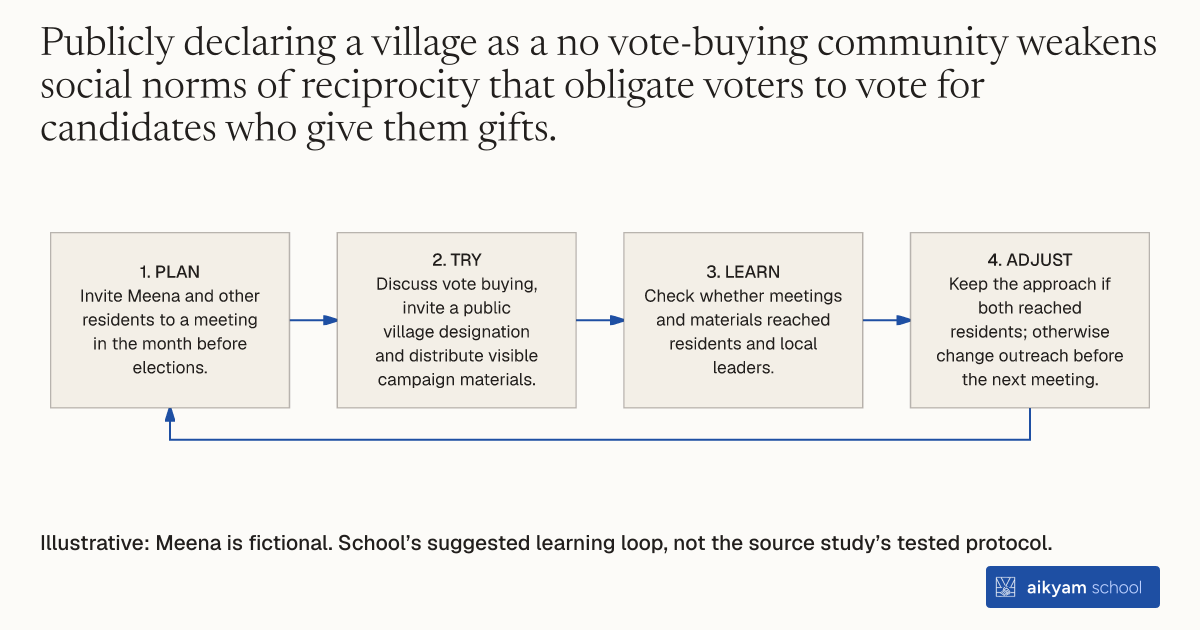
- Plan: Invite Meena and other residents to a meeting in the month before elections.
- Try: Discuss vote buying, invite a public village designation and distribute visible campaign materials.
- Learn: Check whether meetings and materials reached residents and local leaders.
- Adjust: Keep the approach if both reached residents; otherwise change outreach before the next meeting.
Illustrative: Meena is fictional. School’s suggested learning loop, not the source study’s tested protocol.
See source →Meeting participation and visible materials. The Uganda campaign did not reduce vote buying. School’s suggested learning loop, not a source-tested cycle.
How
When to use
Candidates distribute gifts and cash during elections to obligate voters through social reciprocity. Incumbent candidates often possess superior financial resources to purchase votes compared to opposition challengers. Civil society groups use community-wide campaigns to weaken vote-buying norms and level the political playing field.
Organize visible community meetings that invite villages to designate themselves as no vote-buying communities in the month before elections.
- Deploy civic activists to target rural villages during the month preceding national elections.
- Convene community meetings with village residents and local leaders.
- Facilitate discussions on how vote buying undermines democratic accountability and local governance.
- Invite community members to publicly designate their village as a no vote-buying village.
- Distribute visible anti-vote-buying materials across designated villages to signal public commitment to candidates.
Why it works
Highly visible campaigns also signal a leveled playing field, prompting resource-constrained challengers to increase campaign efforts.
Example
In Uganda during the month before the 2016 national elections, activists invited communities to designate themselves as no vote-buying villages, which weakened norms of reciprocity, shifted votes from incumbents to challengers, and led challengers to intensify both vote buying and campaigning.
About the study
Participants
Village communities and voters across Uganda in the month before the 2016 national elections.
Study Design
Randomized field experiment evaluating a large-scale, visible anti-vote-buying campaign against control communities.
Results
The campaign did not reduce the extent of vote buying, but weakened norms of reciprocity, swung votes from incumbents to challengers, and caused challengers to intensify both vote buying and campaigning efforts.