Research steps
Show the baseline voter video
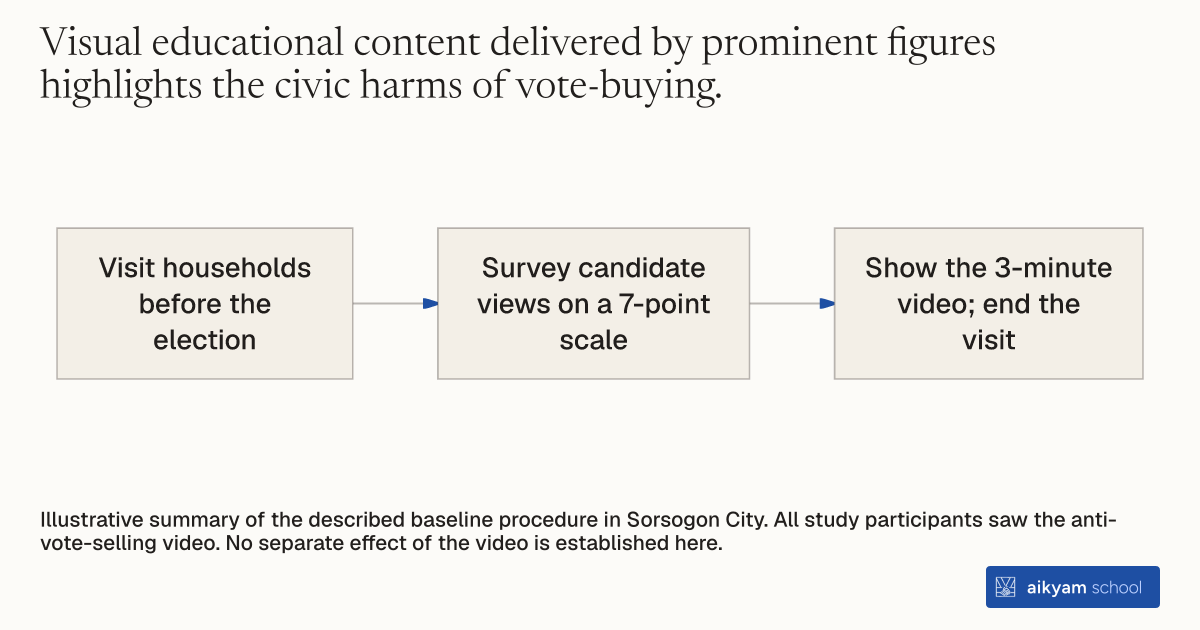
- Visit households before the election
- Survey candidate views on a 7-point scale
- Show the 3-minute video; end the visit
Illustrative summary of the described baseline procedure in Sorsogon City. All study participants saw the anti-vote-selling video. No separate effect of the video is established here.
See source →How
When to use
Municipal elections in developing democracies often face widespread vote-buying by political candidates. Civil society groups need a standardized baseline tool to educate citizens against selling their votes. This method targets registered voters in election districts affected by clientelism and cash offerings.
Screen a brief civic education video to household members during baseline survey visits prior to an election.
- Enumerators visit randomly selected households during the month leading up to an election.
- Enumerators conduct a baseline survey measuring voter favorability toward all local candidates on a 7-point scale.
- Enumerators present a three-minute voter education video featuring a public figure urging voters not to sell their votes.
- Enumerators end the baseline visit immediately following the video screening to maintain a standard baseline intervention.
Why it works
The standardized video ensures uniform exposure to anti-vote-selling messaging across all participants.
Example
In Sorsogon City, Philippines, research teams screened a three-minute anti-vote-selling video to 883 households before the May 2013 municipal elections.
About the study
Participants
883 surveyed households in Sorsogon City, Philippines during the May 2013 municipal elections.
Study Design
Randomized field experiment assessing voter behavior across mayoral, vice-mayoral, and city council elections using a baseline survey, video screening, and a post-election survey.
Results
Serving as the experimental baseline, overall 56% of voters switched their votes in at least one race, with 12% switching in the mayoral election, 22% in the vice-mayoral election, and 44% in the city council election.