Try, learn and adjust
Check voters can verify their electronic ballot
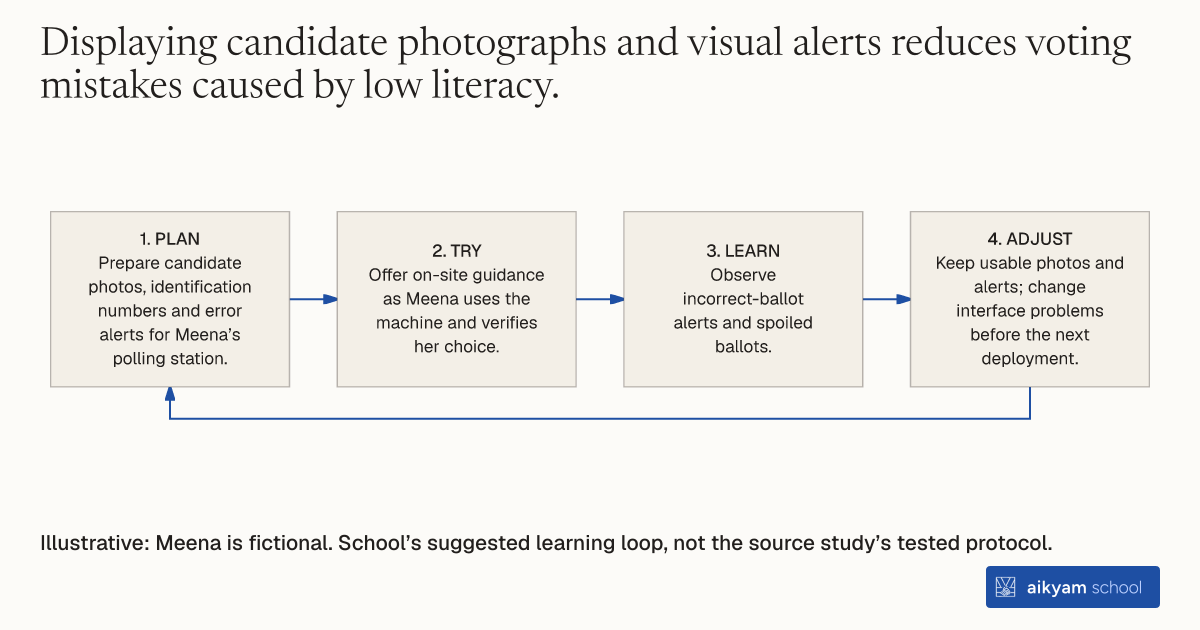
- Plan: Prepare candidate photos, identification numbers and error alerts for Meena’s polling station.
- Try: Offer on-site guidance as Meena uses the machine and verifies her choice.
- Learn: Observe incorrect-ballot alerts and spoiled ballots.
- Adjust: Keep usable photos and alerts; change interface problems before the next deployment.
Illustrative: Meena is fictional. School’s suggested learning loop, not the source study’s tested protocol.
See source →Ballot errors, alerts and candidate verification. School’s suggested learning loop, not a source-tested cycle.
How
When to use
Low-income and illiterate citizens face difficulty navigating paper ballots during elections, resulting in high rates of residual or spoiled votes. Paper voting systems disenfranchise vulnerable voters who lack formal reading skills. Election authorities introduce user-friendly voting technology to make electoral participation accessible to all citizens.
Deploy electronic voting machines equipped with candidate photographs and error-detection alerts to make voting accessible for low-income and illiterate voters.
- Design electronic voting interfaces that display clear candidate photographs alongside candidate identification numbers.
- Incorporate visual alerts that notify voters when a ballot is filled incorrectly before final submission.
- Install electronic voting machines across polling stations during municipal and national elections.
- Allow voters to cast electronic ballots with immediate visual verification of their chosen candidate.
- Provide on-site guidance to help first-time users operate the voting machine interface.
Why it works
User-friendly interfaces enable low-income and illiterate voters to cast valid ballots successfully.
Example
In Brazil, the introduction of electronic voting machines displaying candidate photos and error alerts enfranchised low-income and illiterate voters by reducing spoiled ballots.
About the study
Participants
Low-income and illiterate voters across municipalities in Brazil.
Study Design
Quasi-experimental evaluation examining the rollout of electronic voting machines across municipal population thresholds.
Results
Effectively enfranchised many low-income and illiterate voters by displaying candidate photos and alerting voters when ballots were filled incorrectly.