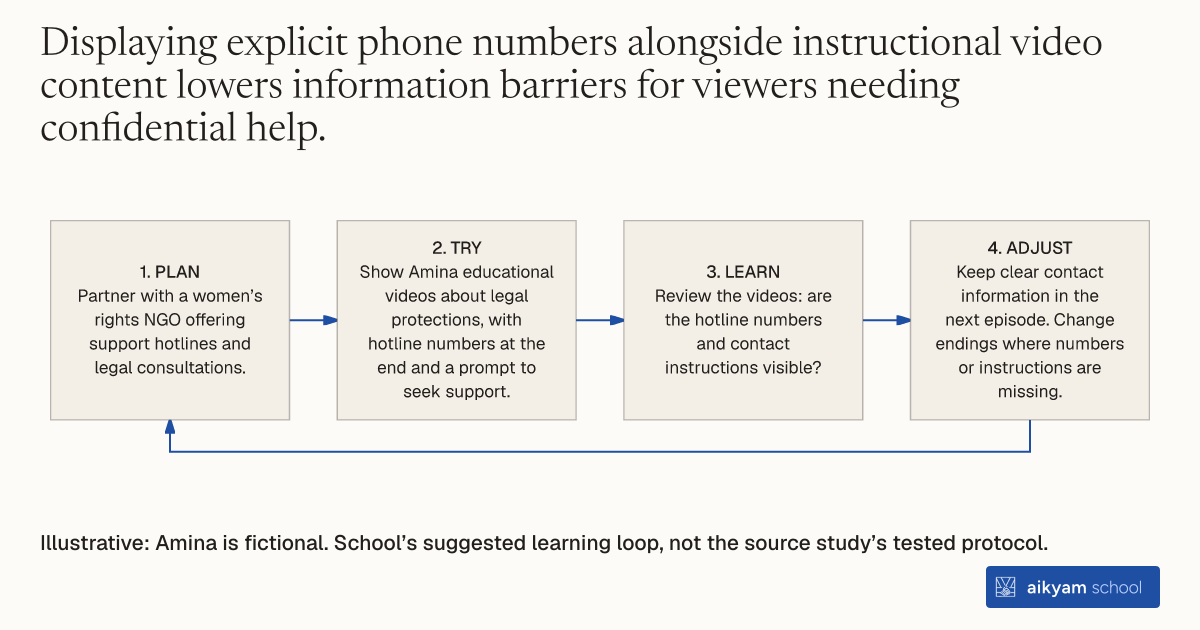
Try, learn and adjust
Check support numbers appear in videos
- Plan: Partner with a women’s rights NGO offering support hotlines and legal consultations.
- Try: Show Amina educational videos about legal protections, with hotline numbers at the end and a prompt to seek support.
- Learn: Review the videos: are the hotline numbers and contact instructions visible?
- Adjust: Keep clear contact information in the next episode. Change endings where numbers or instructions are missing.
Illustrative: Amina is fictional. School’s suggested learning loop, not the source study’s tested protocol.
See source →School’s suggested, untested loop. Observe hotline details and prompts; do not infer that a viewer received legal or psychological support.
How
When to use
Women experiencing domestic or gender-based violence during lockdowns often do not know where to obtain confidential help. Incorporating direct contact details for support services into media broadcasts gives viewers actionable pathways to assistance. This method connects isolated individuals with specialized legal and psychological resources without exposing them to public scrutiny.
Embed support hotline contact details directly within educational video broadcasts to direct viewers toward legal and counseling resources.
- Partner with a specialized women's rights NGO that operates dedicated support hotlines and legal consultation services.
- Produce short educational video segments discussing legal protections, domestic safety, and reporting procedures.
- Feature the hotline telephone numbers prominently on screen at the conclusion of video broadcasts.
- Prompt viewers facing domestic violence or legal challenges to contact the hotline for direct counseling and legal representation.
- Distribute the video episodes regularly across online and satellite television media channels.
Why it works
Presenting hotlines immediately after discussing legal rights encourages viewers to take direct action to address violence.
Example
In Egypt, the Egyptian Center for Women's Rights incorporated its support hotline into 13 educational videos hosted by Nehad Aboul Qomsan, which helped increase accurate participant knowledge of ECWR online resources by 131% to 216% over the control group mean.
About the study
Participants
5,618 female Facebook users in Egypt across governorates and age groups enrolled in the experimental trial, with 4,165 completing the endline survey.
Study Design
Randomized field trial evaluating social media videos and television broadcasts featuring embedded NGO hotline details against a control group.
Results
Featuring NGO hotlines in media content increased accurate knowledge of ECWR resources by 131% to 216% relative to the control group mean, increased hypothetical resource contact by 0.08 to 0.12 standard deviations, and raised recent resource contact by 0.06 to 0.10 standard deviations.