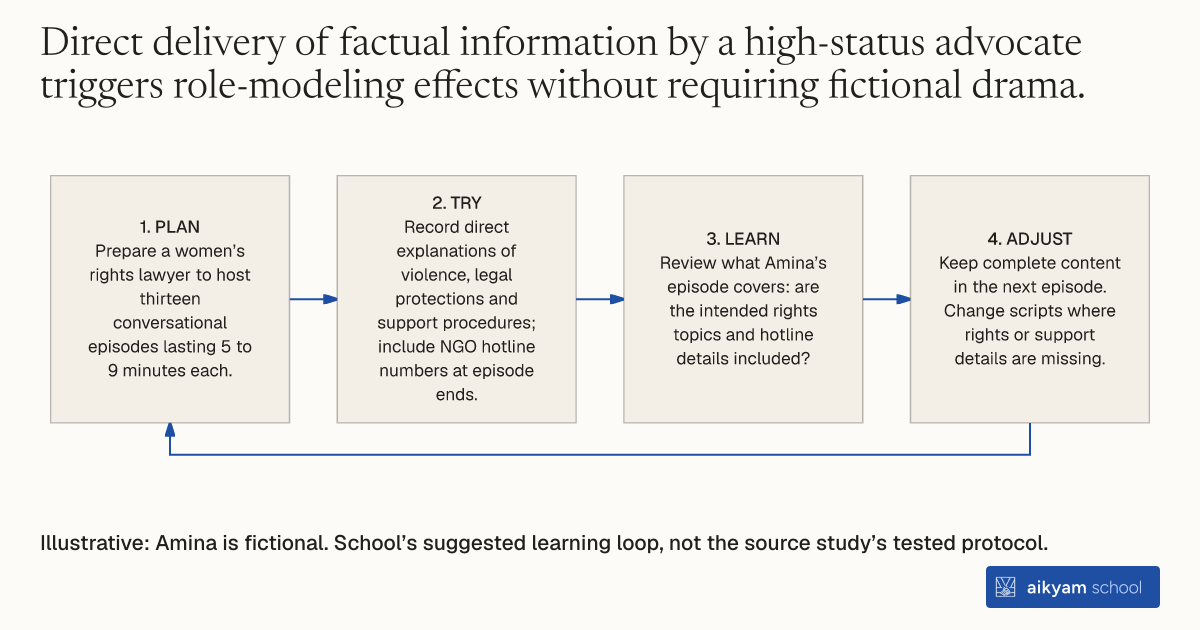
Try, learn and adjust
Check expert videos include rights and support
- Plan: Prepare a women’s rights lawyer to host thirteen conversational episodes lasting 5 to 9 minutes each.
- Try: Record direct explanations of violence, legal protections and support procedures; include NGO hotline numbers at episode ends.
- Learn: Review what Amina’s episode covers: are the intended rights topics and hotline details included?
- Adjust: Keep complete content in the next episode. Change scripts where rights or support details are missing.
Illustrative: Amina is fictional. School’s suggested learning loop, not the source study’s tested protocol.
See source →School’s suggested, untested loop. Observe topic coverage, episode length and contact details; do not infer viewer behaviour from production alone.
How
When to use
In-person community workshops and dramatized media screenings often fail to reach women during social distancing or crisis periods. Creating concise video modules hosted by a trusted advocate delivers essential legal rights and support information directly to online audiences. This method equips women facing gender-based violence with clear guidance without relying on dramatized storylines.
Produce conversational educational video content hosted by an expert to inform women about legal protections and support services.
- Partner with an established women's rights lawyer to present factual information directly in a daytime television setting.
- Draft script topics covering sexual harassment, domestic violence, workplace equality, and legal rights surrounding divorce.
- Record thirteen 5-to-9-minute video episodes in a direct conversational tone addressing the viewer directly.
- Define domestic and public violence beyond physical force and reject blame placed on victims.
- Detail specific procedures for navigating the legal system and preserving evidence following severe violence.
- Formally feature NGO hotline contact details at the end of video episodes.
Why it works
A conversational tone in a studio setting cues personal engagement and lowers barriers to seeking help.
Example
In Egypt, the Egyptian Center for Women's Rights and advocate Nehad Aboul Qomsan produced 13 web videos ranging from 5 to 9 minutes on women's legal rights, increasing participant resource knowledge by 0.225 standard deviations.
About the study
Participants
5,618 female Facebook users in Egypt randomly assigned across treatment and control arms, with 4,165 completing the endline survey.
Study Design
Randomized field trial evaluating thirteen 5-to-9-minute expert-led edutainment videos distributed across social media channels compared to satellite television reminders and a control group.
Results
Social media video delivery increased video content recall by 1.026 standard deviations, increased knowledge of support resources by 0.225 standard deviations, and raised recent resource usage by 0.060 standard deviations.