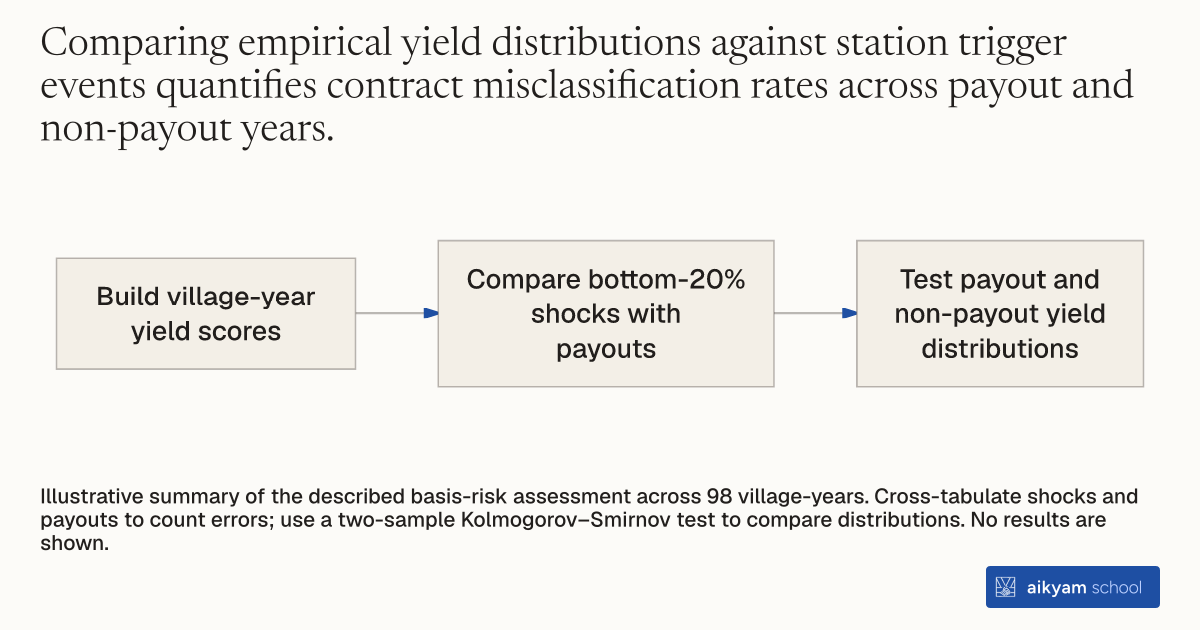
Research steps
Check whether rainfall payouts match yield shocks
- Build village-year yield scores
- Compare bottom-20% shocks with payouts
- Test payout and non-payout yield distributions
Illustrative summary of the described basis-risk assessment across 98 village-years. Cross-tabulate shocks and payouts to count errors; use a two-sample Kolmogorov–Smirnov test to compare distributions. No results are shown.
See source →How
When to use
Index insurance contracts rely on weather station measurements rather than on-farm damage assessments, creating basis risk when station triggers fail to match actual crop losses. Evaluating whether payouts align with objective yield losses helps researchers quantify false-positive and false-negative payout errors. This method targets agricultural insurance designers and researchers evaluating weather index reliability for rural smallholders.
Assess weather index basis risk by testing whether station payout triggers align with empirical village-level crop yield distributions.
- Collect multi-year survey data on plot-level physical yields for insured crops across participating farming villages.
- Calculate normalized yield z-scores per crop and aggregate them into village-year average yield indices.
- Identify village-years where survey yield indices fall in the bottom 20 percent of the historical distribution to indicate true yield shocks.
- Record whether the station rainfall index triggered financial payouts in each corresponding village-year.
- Construct two-by-two cross-tabulation tables comparing index payout occurrences against survey-measured yield shock occurrences to calculate false-positive and false-negative rates.
- Perform a two-sample Kolmogorov-Smirnov test comparing the cumulative density functions of yield distributions between payout and non-payout village-years.
Why it works
Evaluating cumulative distribution functions via Kolmogorov-Smirnov tests verifies whether index payouts correspond to statistically distinct, lower yield realizations.
Example
Researchers evaluated rainfall index basis risk across 98 village-years in Amhara, Ethiopia, finding that the index triggered false-positive payouts in 21 percent of non-shock village-years and paid out in just over half (53 percent) of true yield-shock years.
About the study
Participants
98 village-year observations across 49 study villages in Amhara Region, Ethiopia.
Study Design
Empirical basis risk evaluation comparing station rainfall payouts against bottom-quintile survey yield shocks using two-by-two contingency tables and two-sample Kolmogorov-Smirnov tests of cumulative yield distributions.
Results
Identified false-positive payouts in 21% of non-shock village-years and true payouts in 53% of yield-shock village-years, with a Kolmogorov-Smirnov test confirming significant CDF separation between payout and non-payout yield distributions (p < 0.01).