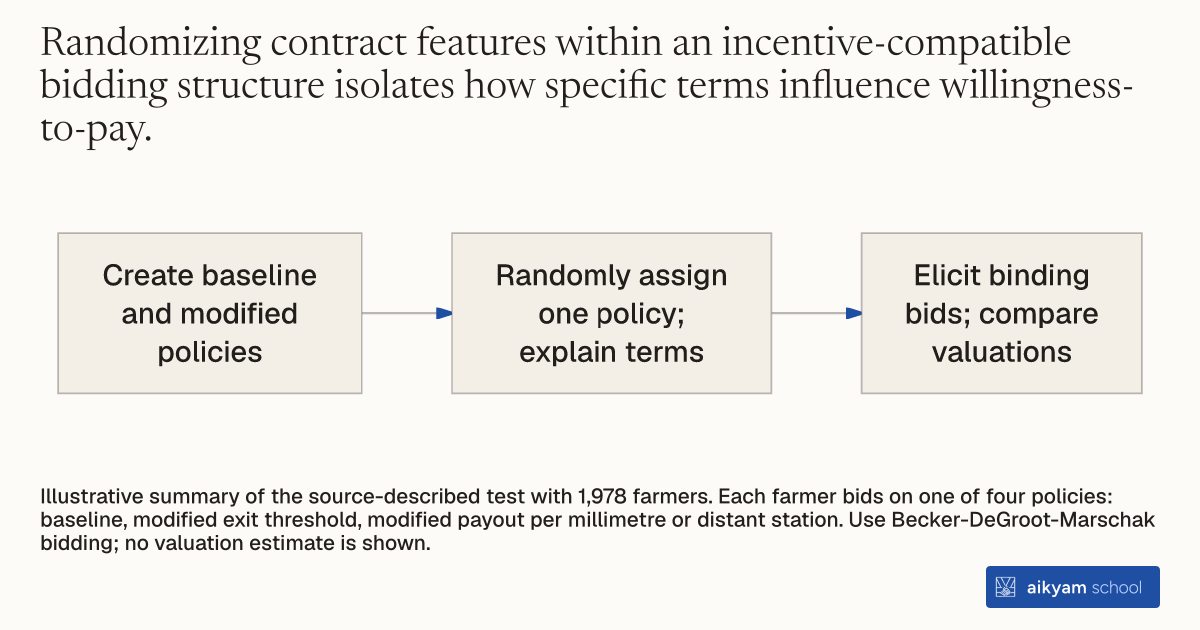
Research procedure
Compare bids across insurance variants
- Create baseline and modified policies
- Randomly assign one policy; explain terms
- Elicit binding bids; compare valuations
Illustrative summary of the source-described test with 1,978 farmers. Each farmer bids on one of four policies: baseline, modified exit threshold, modified payout per millimetre or distant station. Use Becker-DeGroot-Marschak bidding; no valuation estimate is shown.
See source →How
When to use
An agricultural insurance provider needs to evaluate how specific contract modifications affect consumer demand and valuation. Customers may misjudge or disproportionately penalize certain contract tweaks, such as distant weather stations or adjusted trigger thresholds. Field experimenters randomize policy variations during valuation elicitations to measure how contract features alter willingness-to-pay.
Test consumer demand across specific contract parameters by presenting randomized insurance policy variations during incentive-compatible bidding.
- Design a baseline reference insurance policy with standard regional triggers, exit thresholds, and payout rates per millimeter of rainfall deficit.
- Construct modified policy variants that adjust specific terms, including exit thresholds, payout rates per millimeter, or reference station distance.
- Present the randomized policy variations to rural agricultural decision-makers during household visits.
- Explain the precise structural differences between the modified policy variant and the baseline reference policy.
- Elicit binding monetary willingness-to-pay bids for each contract variation using the incentive-compatible Becker-DeGroot-Marschak mechanism.
- Compare bidding responses across contract variations to estimate consumer marginal valuations of specific policy features.
Why it works
This reveals whether consumers rationally price structural policy adjustments or exhibit behavioral biases toward specific features like basis risk.
Example
Enumerators evaluated 1,978 smallholder farmers across villages in Andhra Pradesh, India, eliciting willingness-to-pay across 4 distinct ICICI Lombard insurance policy variants. Compared to the real policy average bid of Rs. 68.40, increasing the exit threshold (increasing expected value by Rs. 40-70) increased bids by Rs. 10.86, reducing per-mm payouts (reducing expected value by Rs. 10-20) reduced bids by Rs. 11.90, and assigning a distant station (basis risk) reduced bids by Rs. 29.45.
About the study
Participants
1,978 smallholder farmers (1,464 existing trial participants and 514 new subjects) across rural villages in Mahbubnagar and Anantapur, Andhra Pradesh, India.
Study Design
Randomized Controlled Trial within an incentive-compatible BDM framework, comparing bids across 4 randomized policy variations (Real, Modified Exit, Modified mm Payment, Basis Risk).
Results
Modifying the exit threshold increased willingness-to-pay by Rs. 10.86 (p < 0.01), reducing mm payouts reduced willingness-to-pay by Rs. 11.90 (p < 0.01), and introducing basis risk reduced willingness-to-pay by Rs. 29.45 (p < 0.01).