Research design
Compare rainfall gauge locations
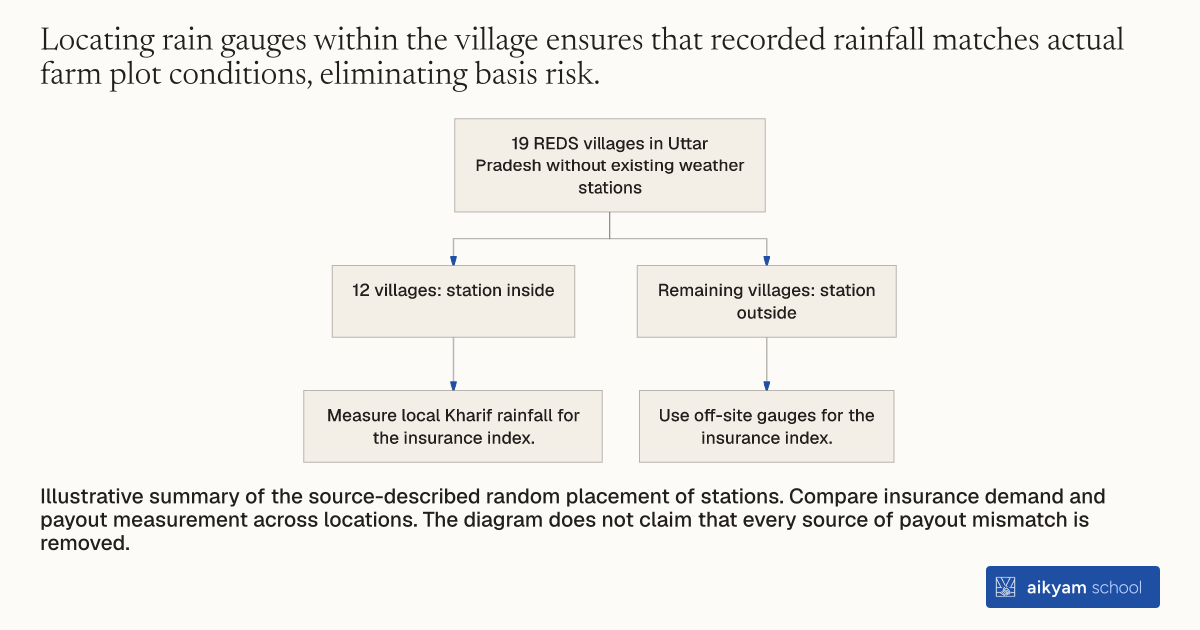
19 REDS villages in Uttar Pradesh without existing weather stations
- 12 villages: station inside
- Measure local Kharif rainfall for the insurance index.
- Remaining villages: station outside
- Use off-site gauges for the insurance index.
Illustrative summary of the source-described random placement of stations. Compare insurance demand and payout measurement across locations. The diagram does not claim that every source of payout mismatch is removed.
See source →How
When to use
Index weather insurance suffers from basis risk when rainfall gauges are located far from agricultural plots, depressing farmer demand. Placing automated weather stations directly within client villages eliminates geographical measurement error for local farmers. This method provides accurate local rainfall tracking to boost formal index insurance adoption.
Position automated weather stations directly inside client villages to minimize geographical measurement error and eliminate basis risk.
- Identify target agricultural villages lacking local government or meteorological weather stations.
- Select candidate villages in study districts to receive on-site automated rainfall measuring stations.
- Install automated weather stations directly within 12 designated treatment villages prior to the crop season.
- Measure daily Kharif season rainfall directly at the in-village gauge to calculate index insurance payouts.
- Benchmark contract payouts against distant off-site weather gauges to evaluate basis risk mitigation.
Why it works
Removing basis risk makes index insurance payouts reliable, encouraging farmers to purchase contracts regardless of their informal safety nets.
Example
Researchers in Uttar Pradesh, India, randomly installed automated weather stations inside 12 of 19 sample REDS villages lacking pre-existing gauges, eliminating distance-based basis risk for local farming households.
About the study
Participants
Cultivators and laborer households across 19 rural REDS villages in Uttar Pradesh, India.
Study Design
Randomized controlled trial randomly placing automated weather stations inside 12 villages while placing remaining stations outside target villages.
Results
Placing weather stations inside the village eliminated basis risk (0 km distance), equalizing index insurance demand across households with and without informal subcaste indemnification.