Research procedure
Ask about hypothetical insurance demand
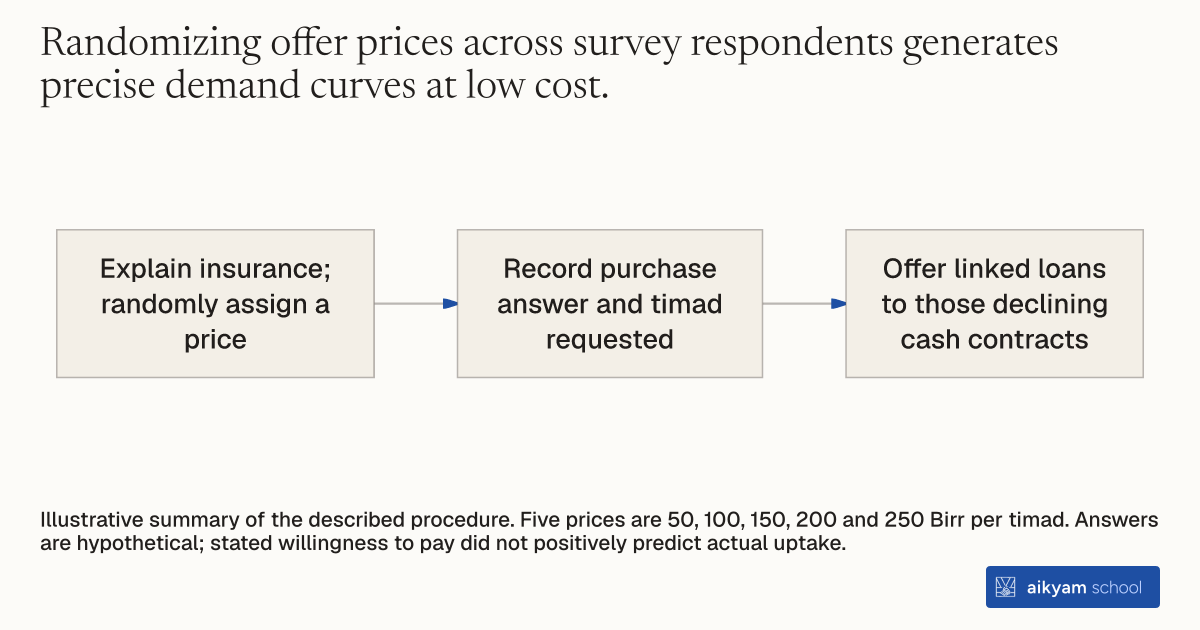
- Explain insurance; randomly assign a price
- Record purchase answer and timad requested
- Offer linked loans to those declining cash contracts
Illustrative summary of the described procedure. Five prices are 50, 100, 150, 200 and 250 Birr per timad. Answers are hypothetical; stated willingness to pay did not positively predict actual uptake.
See source →How
When to use
Smallholder farmers in developing countries face severe climate risks but lack access to formal financial products. Researchers need to measure demand for novel insurance contracts before spending money on full field trials. Conduct this survey to estimate willingness to pay without setting up complex sales logistics.
Measure household willingness to pay for weather index insurance by conducting a contingent valuation survey with randomized price offers across target farmers.
- Visit sampled rural households during baseline survey operations.
- Explain the weather index insurance product using local rainfall measurements and crop damage scenarios.
- Assign a random price level per timad of land to each farmer from five preset price tiers.
- Ask the farmer if they will buy the contract at the assigned price level.
- Record the number of timad the farmer wants to insure if they accept the price.
- Present interlinked loan options to farmers who decline the standalone cash contract.
Why it works
Hypothetical questions allow research teams to test multiple contract variations before forming commercial banking partnerships.
Example
Researchers surveyed 2,399 rural households across 120 Kebeles in Amhara, Ethiopia, offering hypothetical insurance contracts paying 1,000 Birr per timad with randomized prices between 50 and 250 Birr. A total of 1,487 households expressed positive demand, yielding an average willingness to pay of 276.7 Birr per timad.
About the study
Participants
2,399 rural smallholder households across 120 Kebeles in 4 zones of Amhara, Ethiopia.
Study Design
Contingent valuation survey with randomized price levels (50, 100, 150, 200, and 250 Birr per timad) evaluated via probit regressions.
Results
Average stated willingness to pay was 276.7 Birr per timad among interested households, but stated willingness to pay did not positively predict actual uptake during real sales (marginal effect = -0.0777, p < 0.10).