Research steps
Evaluate the campaign through online surveys
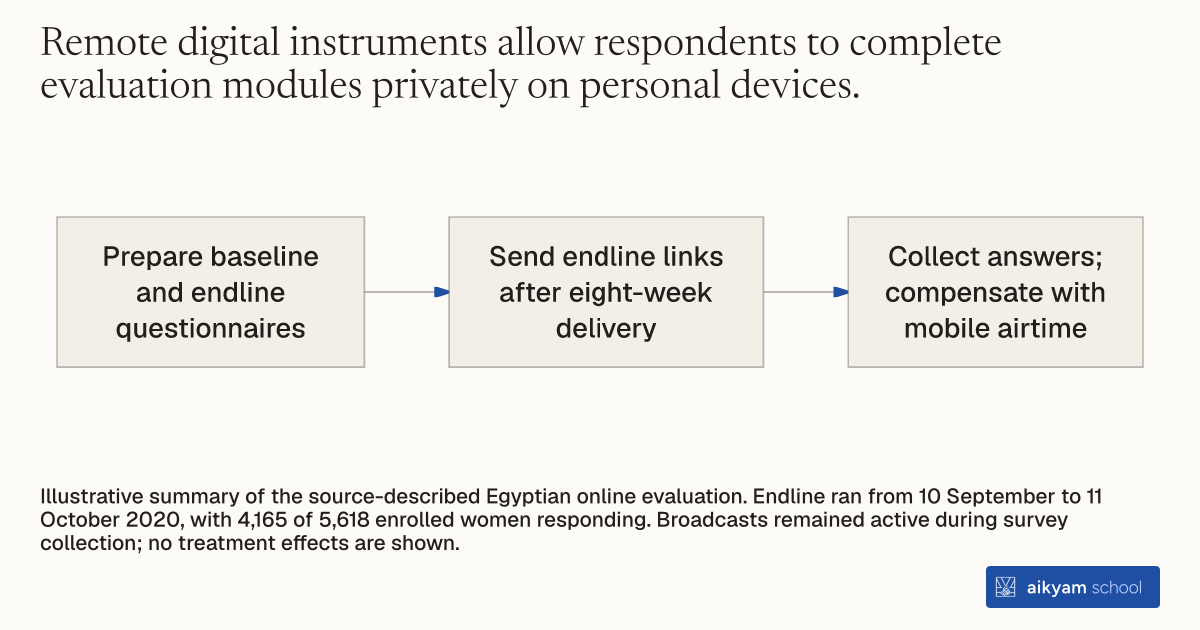
- Prepare baseline and endline questionnaires
- Send endline links after eight-week delivery
- Collect answers; compensate with mobile airtime
Illustrative summary of the source-described Egyptian online evaluation. Endline ran from 10 September to 11 October 2020, with 4,165 of 5,618 enrolled women responding. Broadcasts remained active during survey collection; no treatment effects are shown.
See source →How
When to use
In-person survey collection becomes unfeasible during health crises or mobility restrictions. Web-based questionnaires offer a way to measure program outcomes across geographically dispersed study populations. This method evaluates remote media interventions without risking participant safety.
Field web-based survey questionnaires to evaluate treatment impacts across participant cohorts following campaign completion.
- Design standardized baseline and endline questionnaires on a web-based survey platform.
- Embed direct and indirect questions to measure content recall, resource knowledge, and social attitudes.
- Distribute personalized survey completion links to enrolled program participants after concluding the intervention period.
- Keep intervention broadcasts active and omit notifications about final video completion to minimize social desirability bias.
- Provide financial compensation in mobile phone airtime to complete the endline questionnaire.
Why it works
Concealing the exact end of programming prevents participants from altering answers to please researchers.
Example
In Egypt, researchers fielded an online Qualtrics endline survey from September 10 to October 11, 2020, retaining 4,165 of 5,618 enrolled women to evaluate media campaign effects across knowledge and behavioral domains.
About the study
Participants
4,165 female internet users in Egypt who completed the endline survey out of 5,618 enrolled participants.
Study Design
Randomized field trial evaluating campaign impacts using an online Qualtrics endline survey fielded across treatment and control arms following an 8-week intervention.
Results
The online endline survey achieved a 75% response rate, measuring a 0.225 standard deviation increase in resource knowledge and a 0.060 standard deviation increase in recent resource use.