Research procedure
Follow up mailed questionnaires
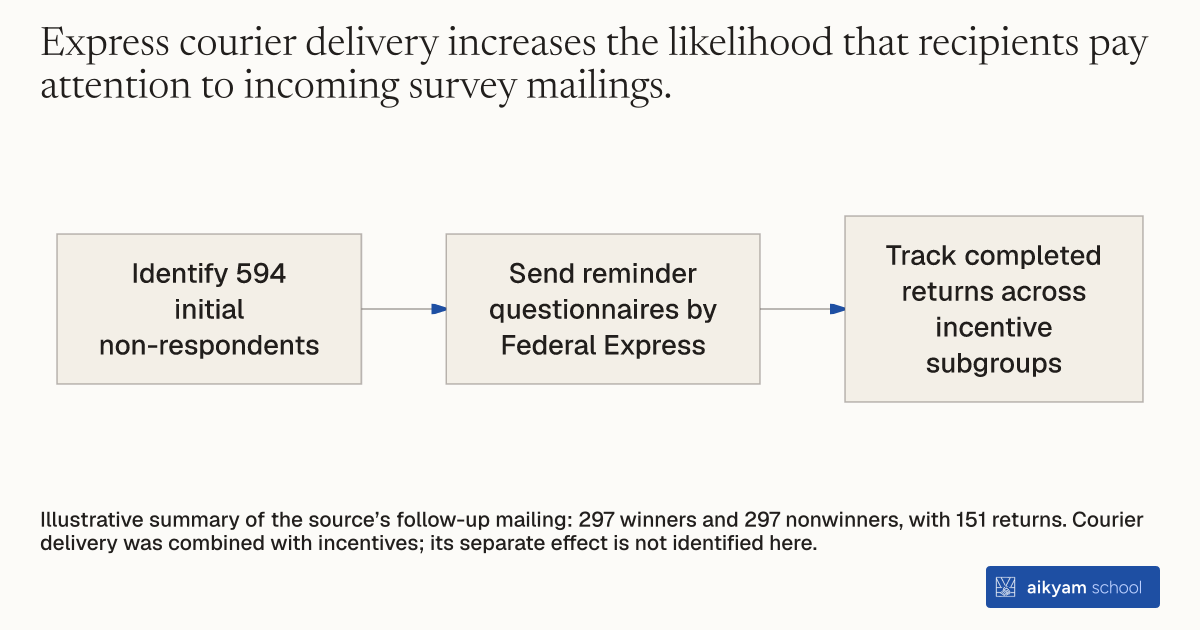
- Identify 594 initial non-respondents
- Send reminder questionnaires by Federal Express
- Track completed returns across incentive subgroups
Illustrative summary of the source’s follow-up mailing: 297 winners and 297 nonwinners, with 151 returns. Courier delivery was combined with incentives; its separate effect is not identified here.
See source →How
When to use
Survey organizers face declining participation when following up with initial nonrespondents in large field studies. Standard postal mailings often go unread or get discarded among routine mail. Delivering follow-up survey packets via express courier services increases delivery visibility and catches the attention of potential respondents.
Use priority express courier services to deliver follow-up questionnaires to initial survey nonrespondents.
- Identify study participants who failed to return questionnaires after initial mailings.
- Prepare follow-up survey packets containing reminder letters and replacement questionnaires.
- Package the follow-up materials inside branded express courier envelopes.
- Dispatch the survey packages to nonrespondent home addresses using Federal Express courier services.
- Track returned completed questionnaires to record follow-up response rates.
Example
Researchers sent follow-up survey packages via Federal Express to 594 nonresponding lottery players in Massachusetts, securing 151 returned questionnaires across check and cash incentive subgroups.
About the study
Participants
594 lottery player survey nonrespondents (297 winners and 297 nonwinners) in Massachusetts.
Study Design
Express delivery follow-up field trial sending reminder questionnaire packages via Federal Express to nonrespondents combined with financial incentive offers.
Results
Delivering follow-up mailings via Federal Express to 594 nonrespondents yielded 151 completed survey returns, raising the study's overall response rate from 38 percent in the main mailing to 46 percent overall.