Research design
Compare survey payment timing
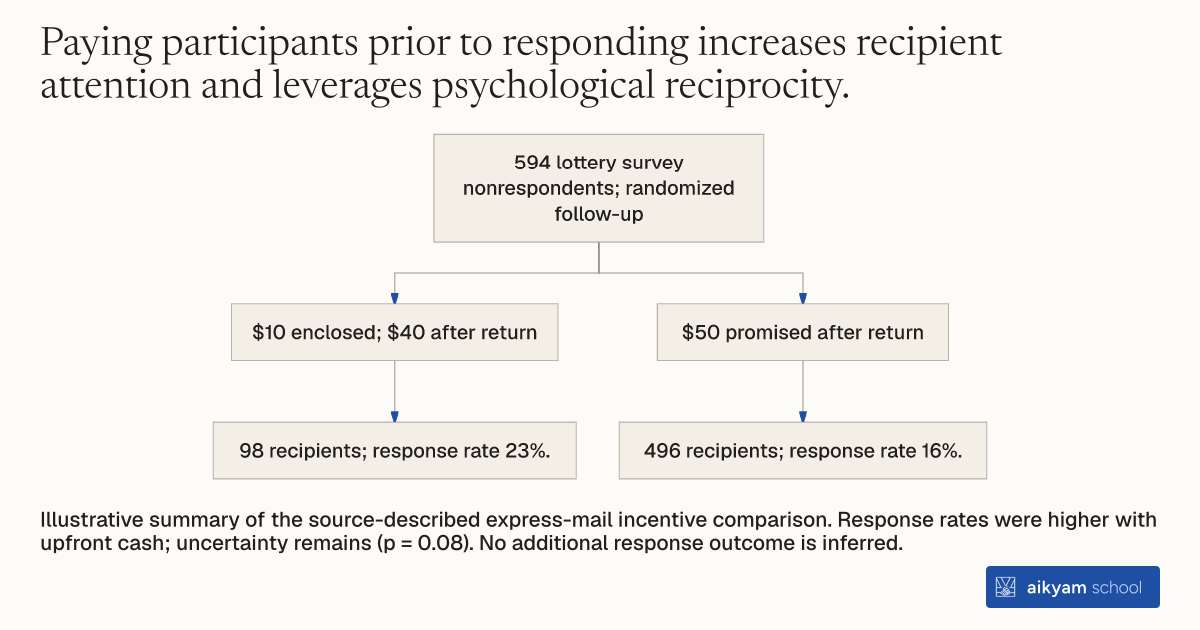
594 lottery survey nonrespondents; randomized follow-up
- $10 enclosed; $40 after return
- 98 recipients; response rate 23%.
- $50 promised after return
- 496 recipients; response rate 16%.
Illustrative summary of the source-described express-mail incentive comparison. Response rates were higher with upfront cash; uncertainty remains (p = 0.08). No additional response outcome is inferred.
See source →How
When to use
Survey organizers face low participation rates when re-contacting nonrespondents in large-scale studies. Standard promised rewards paid after completion offer weak motivation to potential participants. Enclosing an immediate cash gift increases attention and completion rates among hard-to-reach subjects.
Enclose a small cash gift inside initial mailings to nonrespondents alongside a promise of additional payment upon completion.
- Identify survey nonrespondents who failed to reply to earlier questionnaire mailings.
- Mail a follow-up packet containing a 10 dollar cash bill directly inside the envelope.
- Include a written offer promising an additional 40 dollar check upon receipt of the completed survey.
- Deliver the packet using express mail services to maximize recipient visibility.
- Send out the remaining 40 dollar check once the completed questionnaire is returned.
Why it works
Potential respondents pay closer attention to survey mailings when physical cash is included up front.
Example
Researchers sent follow-up survey packages to 98 nonrespondents containing a 10 dollar bill and a promise of 40 dollars more, while 496 nonrespondents received only an offer for a 50 dollar check. The group receiving the 10 dollar cash bill up front achieved a 23 percent response rate compared to 16 percent for the check offer alone.
About the study
Participants
594 lottery player survey nonrespondents (297 winners and 297 nonwinners) in Massachusetts.
Study Design
Randomized field experiment comparing an upfront 10 dollar cash enclosure plus 40 dollar conditional check against a 50 dollar conditional check delivered via Federal Express.
Results
Upfront cash increased response rates from 16 percent to 23 percent (t-statistic = 1.81, p-value = 0.08).