Research survey
Compare reported constraints outside the trial
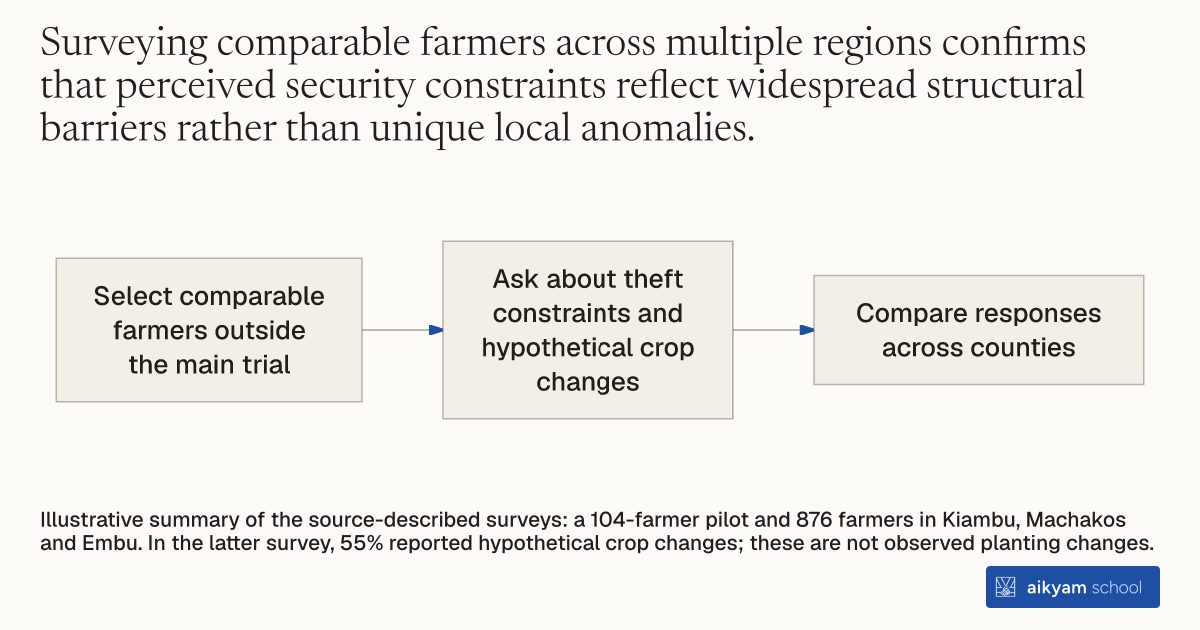
- Select comparable farmers outside the main trial
- Ask about theft constraints and hypothetical crop changes
- Compare responses across counties
Illustrative summary of the source-described surveys: a 104-farmer pilot and 876 farmers in Kiambu, Machakos and Embu. In the latter survey, 55% reported hypothetical crop changes; these are not observed planting changes.
See source →How
When to use
Researchers testing local agricultural interventions often struggle to prove that their findings apply beyond a single study area. Local crime patterns or crop preferences might not reflect conditions in other rural regions. This method uses pilot surveys across multiple distinct counties to confirm that security constraints and crop choices are broadly representative.
Evaluate the external validity of local agricultural security constraints by conducting pilot surveys across geographically diverse agricultural regions.
- Select pilot survey samples of comparable smallholder farmers from adjacent or distinct agricultural counties outside the primary study site.
- Exclude pilot survey participants from the main experimental trial sample to prevent study contamination.
- Administer structured questionnaires to measure how security concerns constrain specific crop choices and land allocation.
- Elicit hypothetical production changes farmers would make if their farm plots received dedicated watchman protection.
- Compare survey responses across different counties to verify that security constraints and agricultural responses generalize across regions.
Why it works
Demonstrating consistent hypothetical responses across diverse counties validates the external relevance of experimental trial findings.
Example
A researcher surveyed 104 comparable smallholders in a pilot study and 876 smallholders across Kiambu, Machakos, and Embu counties in Kenya. Fifty-five percent of surveyed farmers reported that they would plant more valuable crops if a watchman secured their farms, demonstrating broad external validity across Kenya.
About the study
Participants
104 smallholding farmers in a pilot survey sample, supplemented by 876 smallholding farmers across Kiambu, Machakos, and Embu counties, Kenya.
Study Design
Cross-sectional pilot and external validation surveys administered to non-trial smallholders to measure theft-constrained crops and hypothetical watchman adoption responses.
Results
55% of surveyed farmers across Kiambu, Machakos, and Embu reported they would reallocate land to plant more valuable crops if secured by a watchman, while pilot data identified tomatoes, melons, kale, cabbage, and spinach as the top five theft-constrained crops.