Research steps
Track the same farming households across rounds
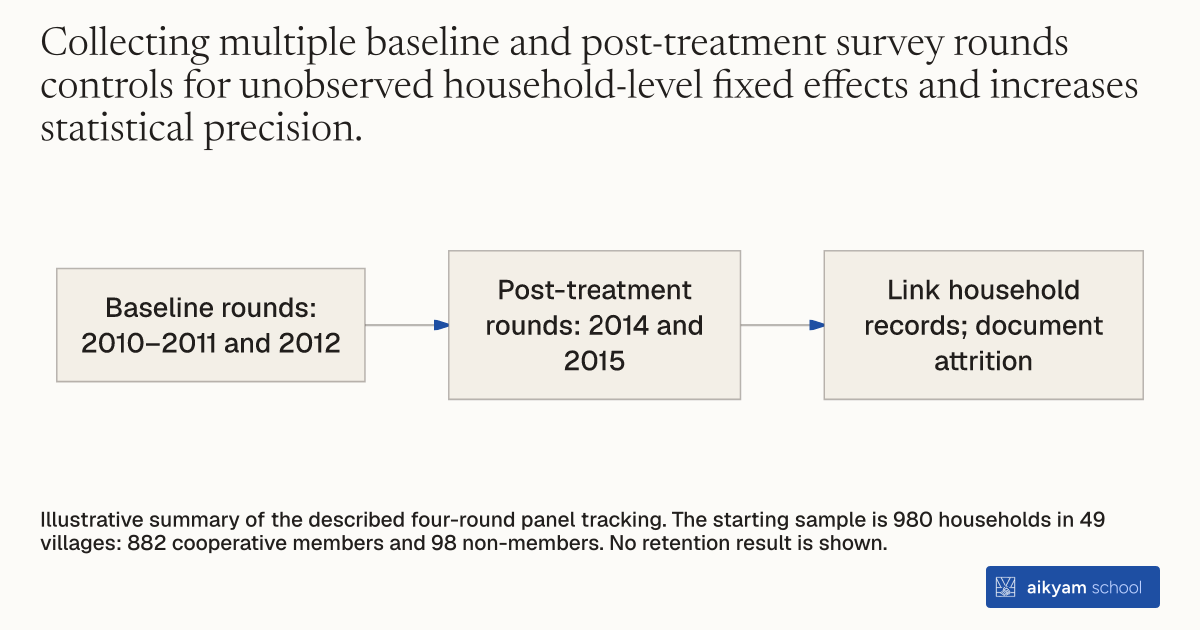
- Baseline rounds: 2010–2011 and 2012
- Post-treatment rounds: 2014 and 2015
- Link household records; document attrition
Illustrative summary of the described four-round panel tracking. The starting sample is 980 households in 49 villages: 882 cooperative members and 98 non-members. No retention result is shown.
See source →How
When to use
Rural households in developing regions experience seasonal weather shocks and input variations that cross-sectional surveys cannot capture. Tracking farming families across multiple agricultural years provides longitudinal panel data on input adoption, yields, and welfare outcomes. This method targets rural agricultural households participating in multi-year policy interventions.
Track rural farming households across multiple survey waves to gather longitudinal panel data on agricultural choices and welfare changes.
- Sample agricultural cooperative member households and non-cooperative farming households from rural village membership rosters.
- Conduct an initial baseline survey recording household demographics, asset holdings, credit constraint status, and risk preferences.
- Perform a second pre-treatment survey round collecting plot-level agricultural metrics to improve baseline outcome precision.
- Administer post-treatment panel survey rounds following main harvest seasons across consecutive sales years.
- Deploy field enumerators to locate original household heads, updating contact logs and documenting causes for household attrition.
- Compile panel datasets linking individual household records across all survey waves to track program impacts over time.
Why it works
Longitudinal household tracking across sales years allows researchers to isolate immediate treatment impacts from lagged dynamic responses.
Example
Survey teams tracked 20 farming households per village across 4 panel survey waves in 49 villages in Amhara, Ethiopia, achieving a four-round household retention rate of 92.5 percent.
About the study
Participants
980 total panel households (882 cooperative members and 98 non-cooperative households) across 49 villages in Amhara Region, Ethiopia.
Study Design
Four-round longitudinal panel survey tracking households across two baseline rounds (2010-2011, 2012) and two post-treatment rounds (2014, 2015).
Results
Achieved a 92.5 percent four-round household tracking rate, with household attrition reaching 9 percent in control villages without significant differential attrition across voucher treatment arms.