Try, learn and adjust
Check support reaches the designated woman
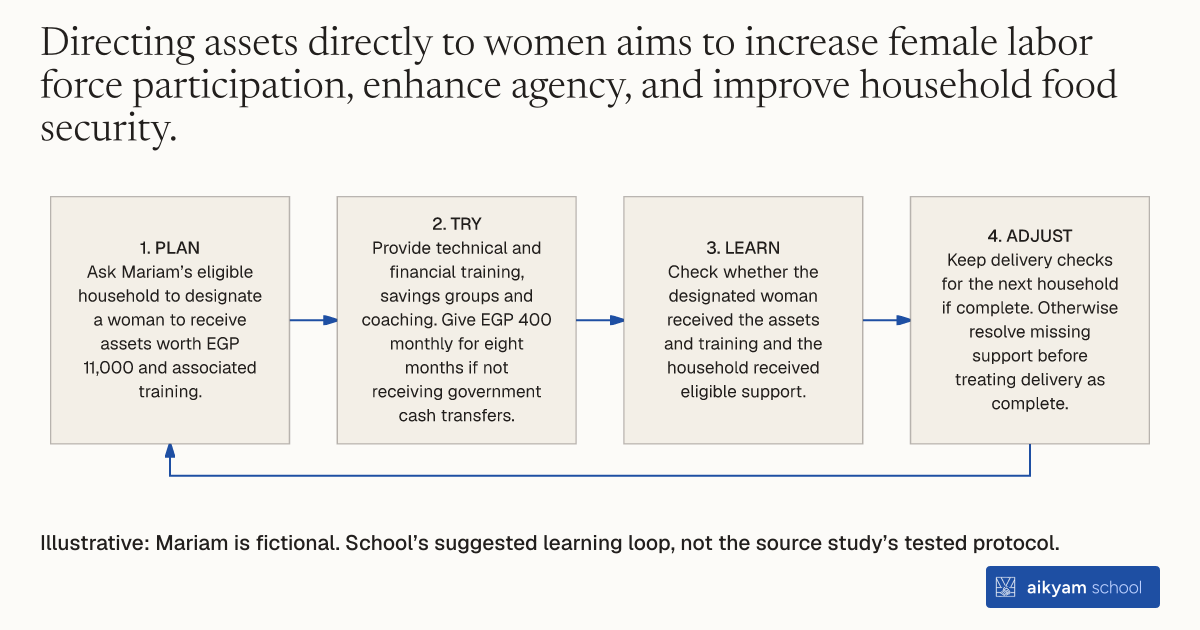
- Plan: Ask Mariam’s eligible household to designate a woman to receive assets worth EGP 11,000 and associated training.
- Try: Provide technical and financial training, savings groups and coaching. Give EGP 400 monthly for eight months if not receiving government cash transfers.
- Learn: Check whether the designated woman received the assets and training and the household received eligible support.
- Adjust: Keep delivery checks for the next household if complete. Otherwise resolve missing support before treating delivery as complete.
Illustrative: Mariam is fictional. School’s suggested learning loop, not the source study’s tested protocol.
See source →School’s suggested, untested loop: observe female-designated receipt and bundle delivery. This check does not establish women’s empowerment effects.
How
When to use
Ultra-poor rural households often face deep economic inequality, with female family members having limited access to productive assets and independent income. Program designers frequently mandate female asset ownership to boost women's status and household outcomes. This method applies to graduation programs serving impoverished families in rural developing regions.
Require that ultra-poor households designate a female member as the sole recipient of transferred productive assets and business training.
- Select eligible ultra-poor households in targeted rural villages.
- Mandate that each participating household choose a female member as the official recipient of productive assets worth EGP 11,000.
- Provide the designated female recipient with technical skills training and financial education.
- Distribute EGP 400 in monthly consumption support for 8 months to households not enrolled in government cash transfers.
- Involve participants in regular savings groups, coaching visits, and community solidarity committees.
Why it works
However, the trial shows that where household preferences naturally align with female management, restricting asset receipt yields similar impacts to unrestricted allocation.
Example
In rural Assiut and Sohag governorates, program implementers required treated households in the full-cost restricted arm to nominate a woman to receive assets and training. At endline (40 months), average monthly total expenditure reached EGP 4,520 in this arm compared to EGP 4,272 in the control group.
About the study
Participants
3,465 ultra-poor households in rural villages of Assiut and Sohag governorates, Upper Egypt.
Study Design
Randomized controlled trial comparing full-cost restricted (female-designated), full-cost unrestricted, half-cost, and control arms over 20-month midline and 40-month endline follow-ups.
Results
Total livestock value in the restricted arm reached EGP 9,740 at midline and EGP 12,001 at endline, compared to EGP 1,498 and EGP 3,350 in control; monthly expenditure reached EGP 4,520 at endline versus EGP 4,272 in control; female empowerment index increased by 0.04 standard deviations.