Try, learn and adjust
Check the half-cost bundle retains its support
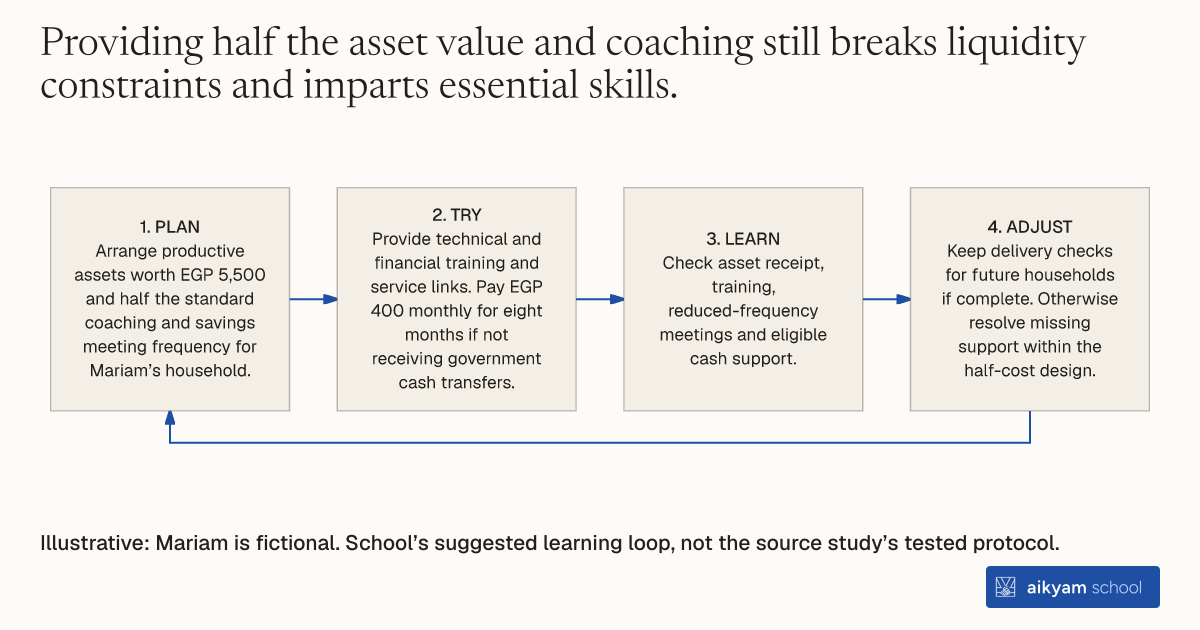
- Plan: Arrange productive assets worth EGP 5,500 and half the standard coaching and savings meeting frequency for Mariam’s household.
- Try: Provide technical and financial training and service links. Pay EGP 400 monthly for eight months if not receiving government cash transfers.
- Learn: Check asset receipt, training, reduced-frequency meetings and eligible cash support.
- Adjust: Keep delivery checks for future households if complete. Otherwise resolve missing support within the half-cost design.
Illustrative: Mariam is fictional. School’s suggested learning loop, not the source study’s tested protocol.
See source →School’s suggested, untested loop: observe the whole half-cost bundle without changing its tested asset value or contact frequency.
How
When to use
Governments and development organisations often face budget constraints that prevent them from scaling expensive full-cost graduation packages. This reduced-intensity model provides a lower-cost alternative to improve living standards for ultra-poor households. It applies to poverty alleviation programs in rural areas with limited funding.
Implement a lower-cost graduation bundle by halving asset values and contact frequency while retaining core support components.
- Target ultra-poor households in rural villages of Upper Egypt.
- Transfer productive assets worth EGP 5,500 per household, halving the standard asset transfer value.
- Provide financial and technical skills training relevant to the selected enterprise.
- Distribute EGP 400 in monthly consumption support for 8 months to eligible households not receiving government cash transfers.
- Reduce coaching home visits and savings group meetings to half the standard program frequency.
- Connect participants to government social services and local solidarity committees.
Why it works
The source notes that a less intensive program can still help households achieve lasting gains at a lower cost per beneficiary.
Example
In Assiut and Sohag governorates, ultra-poor households received the half-cost graduation variant. Total livestock wealth in this group increased to EGP 6,858 at midline and EGP 9,493 at 40-month endline, compared to EGP 3,350 in the control group.
About the study
Participants
3,465 ultra-poor households in rural villages of Assiut and Sohag governorates, Upper Egypt.
Study Design
Randomized controlled trial comparing half-cost, full-cost unrestricted, full-cost restricted, and control groups over 20-month midline and 40-month endline follow-ups.
Results
Total livestock value reached EGP 6,858 at midline and EGP 9,493 at endline compared to EGP 3,350 in control; total monthly expenditure reached EGP 4,448 at endline versus EGP 4,272 in control; total monthly income reached EGP 3,083 at endline versus EGP 2,794 in control; female empowerment index increased by 0.05 standard deviations.