Research overview
Compare transfer recipients
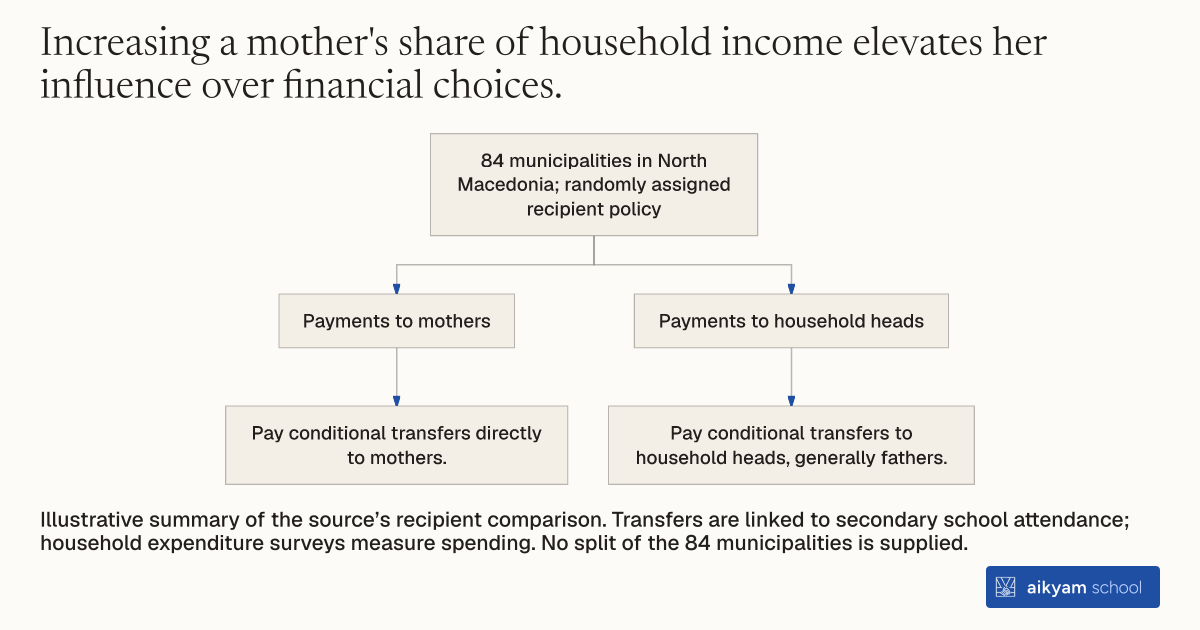
84 municipalities in North Macedonia; randomly assigned recipient policy
- Payments to mothers
- Pay conditional transfers directly to mothers.
- Payments to household heads
- Pay conditional transfers to household heads, generally fathers.
Illustrative summary of the source’s recipient comparison. Transfers are linked to secondary school attendance; household expenditure surveys measure spending. No split of the 84 municipalities is supplied.
See source →How
When to use
A government wants to improve child wellbeing and increase female decision-making power in poor households. Standard income assistance often goes to male household heads and fails to boost nutrition or female agency. Directing financial aid specifically to mothers shifts household spending toward food and strengthens women's influence.
Allocate conditional cash transfer payments directly to mothers rather than male household heads.
- Identify low-income households with children through a national social assistance register.
- Assign mothers as the designated recipients for cash transfer disbursements.
- Pay conditional cash transfers directly to mothers across targeted regions.
- Link ongoing transfer payments to secondary school attendance requirements.
Why it works
Mothers consistently allocate a larger portion of funds to family nutrition and child health than fathers do.
Example
In North Macedonia, researchers evaluated a nationwide secondary school cash transfer program across 84 municipalities. Assigning transfers to mothers increased the household budget share spent on food by 3.9 percentage points compared to assigning transfers to fathers.
About the study
Participants
Low-income households eligible for social assistance across 84 municipalities in North Macedonia, including 768 urban women in a follow-up study.
Study Design
Randomized controlled trial allocating 84 municipalities to transfer payments to either mothers or male household heads, measured using baseline and follow-up household expenditure surveys.
Results
Directing transfers to mothers raised the food expenditure share by 3.9 percentage points over a 55.1 percent baseline and increased mothers' income share by 17 to 21 percentage points.