Try, learn and adjust
Check livestock support matches enterprise choice
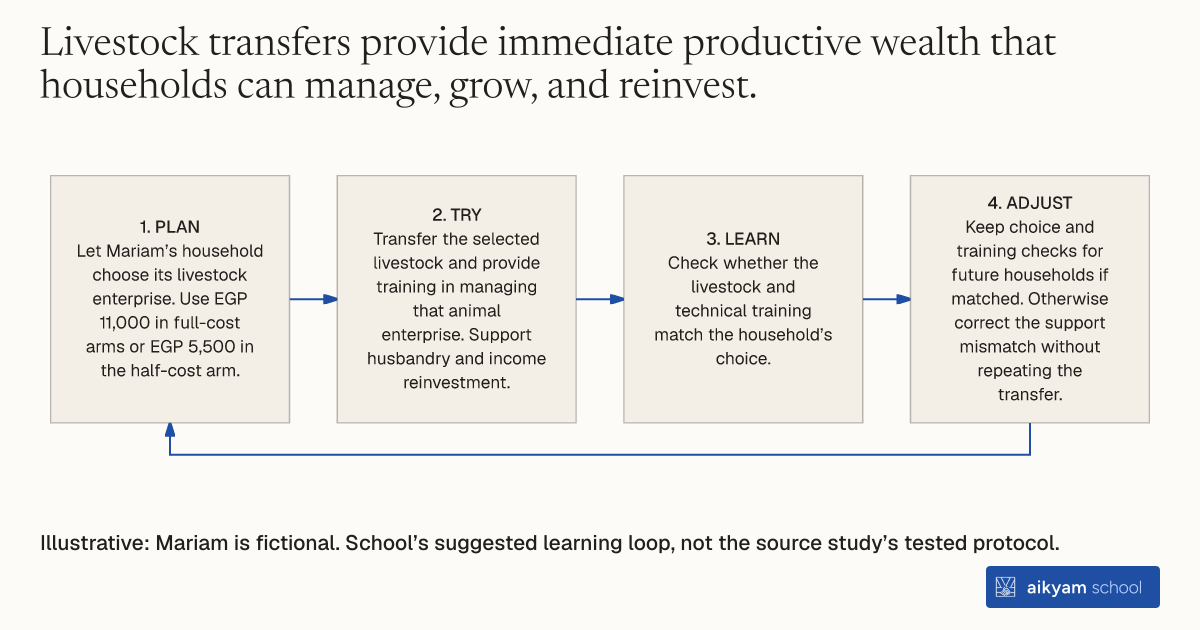
- Plan: Let Mariam’s household choose its livestock enterprise. Use EGP 11,000 in full-cost arms or EGP 5,500 in the half-cost arm.
- Try: Transfer the selected livestock and provide training in managing that animal enterprise. Support husbandry and income reinvestment.
- Learn: Check whether the livestock and technical training match the household’s choice.
- Adjust: Keep choice and training checks for future households if matched. Otherwise correct the support mismatch without repeating the transfer.
Illustrative: Mariam is fictional. School’s suggested learning loop, not the source study’s tested protocol.
See source →School’s suggested, untested loop: observe enterprise choice, assigned asset value and relevant training. Assets are part of a graduation bundle.
How
When to use
Ultra-poor households in rural areas lack productive wealth to generate regular income or food. Transferring small to medium livestock provides a direct asset base for vulnerable families. This method serves impoverished households in rural regions of developing countries.
Transfer selected productive livestock assets worth up to EGP 11,000 to ultra-poor households alongside enterprise training.
- Allow participating ultra-poor households to choose their preferred livestock enterprise.
- Transfer livestock assets valued at EGP 11,000 for full-cost arms or EGP 5,500 for the half-cost arm.
- Provide technical skills training specific to managing and rearing the chosen animal enterprise.
- Support beneficiaries in accumulating larger livestock assets through ongoing animal husbandry and income reinvestment.
Why it works
Medium and large livestock produce regular food outputs like milk while building long-term household wealth.
Example
In Assiut and Sohag governorates, approximately 80% of participating households selected medium livestock like sheep and goats. Beneficiaries successfully converted these initial holdings into larger assets, increasing total livestock holdings across all treatment groups.
About the study
Participants
3,465 ultra-poor households in rural villages of Assiut and Sohag governorates, Upper Egypt.
Study Design
Randomized controlled trial comparing full-cost and half-cost graduation interventions against a control group over 20-month midline and 40-month endline follow-ups.
Results
Total livestock value quadrupled in full-cost arms to EGP 12,580 at 40-month endline and nearly tripled in the half-cost arm to EGP 9,493, compared to EGP 3,350 in the control group.