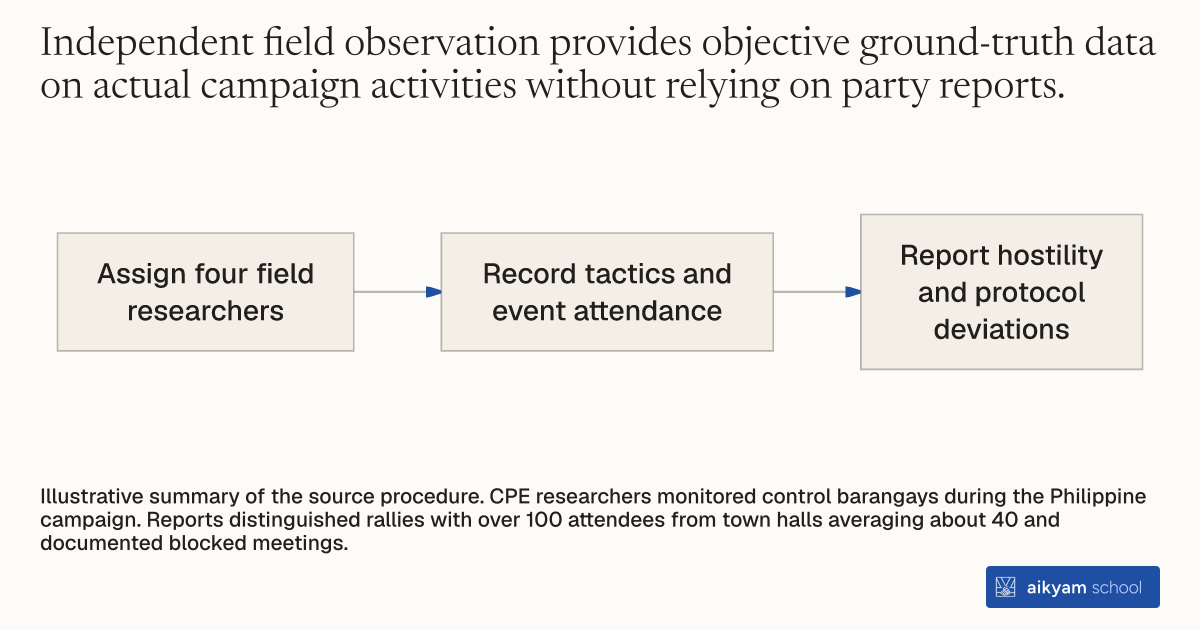
Research procedure
Monitor campaign activity in the field
- Assign four field researchers
- Record tactics and event attendance
- Report hostility and protocol deviations
Illustrative summary of the source procedure. CPE researchers monitored control barangays during the Philippine campaign. Reports distinguished rallies with over 100 attendees from town halls averaging about 40 and documented blocked meetings.
See source →How
When to use
A research organization or political campaign needs to verify campaign compliance and monitor field tactics during an election. Standard self-reporting by political parties often yields incomplete or biased information regarding actual voter outreach. Deploying dedicated observers to local communities allows organizers to track on-the-ground campaign activities independently.
Deploy trained field observers to track political campaign tactics and monitor experimental protocol compliance across local communities.
- Engage four field researchers from a local non-governmental organization to observe campaign operations.
- Assign researchers to monitor campaign presence and outreach efforts across designated local communities throughout the campaign period.
- Observe and document specific campaign communication tactics, including mobile sound systems, door-to-door flyer distribution, and public rallies.
- Record participant attendance at public events, noting whether rallies exceed 100 attendees or town halls average 40 attendees.
- Compile field reports documenting local authority hostility or protocol deviations that require adjusting field operations.
Why it works
Continuous monitoring detects local political interference early and verifies whether control areas maintain standard communication practices.
Example
The Center for Popular Empowerment engaged four field researchers to monitor Akbayan and Umalab Ka campaign strategies across control barangays in Metro Manila and Calabarzon during the May 2013 election in the Philippines. Field observers reported that parties deployed roving sound systems and door-to-door canvassers distributing flyers, while party rallies averaged over 100 participants per event. Field monitoring also identified local official hostility in Marikina, Valenzuela, and Luisiana, documenting necessary adjustments where town halls could not proceed as originally assigned.
About the study
Participants
39 barangays across 13 municipalities in Metro Manila and Calabarzon, Philippines, monitored by 4 CPE field researchers.
Study Design
Observational field monitoring embedded within a two-stage randomized campaign experiment to track control group activities and verify treatment protocol compliance.
Results
Field monitoring tracked campaign activities across 39 barangays, documenting that control rallies averaged over 100 attendees compared to ~40 at town halls, and identifying 3 non-compliant barangays where hostile local officials blocked planned meetings.