Research procedure
Estimate effects with incomplete implementation
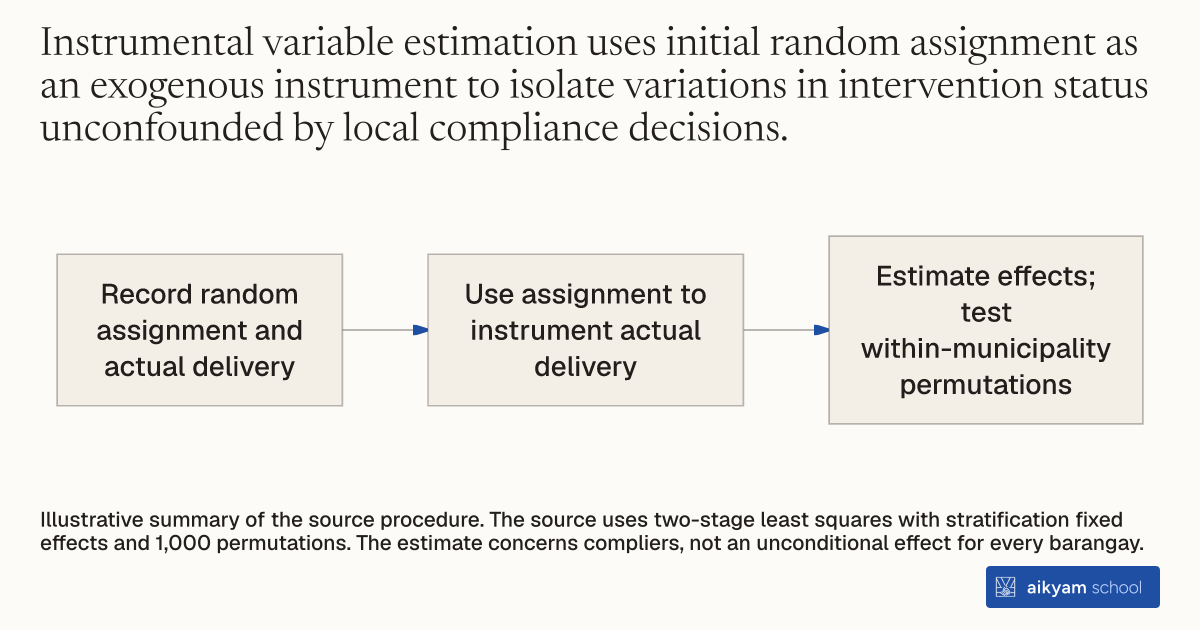
- Record random assignment and actual delivery
- Use assignment to instrument actual delivery
- Estimate effects; test within-municipality permutations
Illustrative summary of the source procedure. The source uses two-stage least squares with stratification fixed effects and 1,000 permutations. The estimate concerns compliers, not an unconditional effect for every barangay.
See source →How
When to use
Researchers evaluate field interventions where local administrative compliance falls short of full protocol execution. In actual field settings, local authorities or logistics problems can force some assigned units to swap or drop treatment status. Estimating treatment effects with instrumental variable regressions instruments actual implementation with initial random assignment to isolate unbiased causal impacts on compliant units.
Estimate complier average causal effects in randomized field trials with protocol non-compliance by instrumenting actual intervention implementation with original random treatment assignment.
- Define a binary assigned treatment indicator equal to one for units randomly assigned to intervention status and zero otherwise.
- Define an actual implementation indicator equal to one for units where the intervention occurred and zero for non-compliant units.
- Specify a two-stage least squares model relating observed outcomes to actual intervention status while controlling for stratification fixed effects.
- Instrument the actual intervention indicator using the initial randomized assignment indicator in the first-stage equation.
- Estimate the model using two-stage least squares to obtain the complier average causal effect for compliant units.
- Calculate statistical significance using non-parametric permutation tests shuffling assigned treatment within stratifying blocks.
Why it works
Isolating treatment variation driven strictly by initial assignment removes selection bias introduced when local conditions prevent intervention execution.
Example
During the 2013 campaign experiment in the Philippines, local official hostility in Marikina, Valenzuela, and Luisiana forced campaign organizers to swap or relocate town-hall meetings across three assigned barangays. Researchers instrumented actual town-hall implementation using initial random barangay assignment to estimate complier average causal effects across 39 barangays. Two-stage least squares estimation revealed that town-hall implementation increased official party vote share by 1.425 percentage points among complier barangays, representing a 60 percent relative increase over the control baseline.
About the study
Participants
39 barangays across 13 municipalities in Metro Manila and Calabarzon, Philippines, covering 1,082 survey respondents and official precinct voting records.
Study Design
Two-stage least squares instrumental variable estimation instrumenting actual town-hall meeting implementation with randomized treatment assignment, evaluated with 1,000 within-municipality permutations.
Results
Instrumental variable estimation showed that town-hall implementation increased official vote shares by 1.425 percentage points among complier barangays (permutation p = 0.005) and increased individual self-reported voting probability by 17.722 percentage points overall.