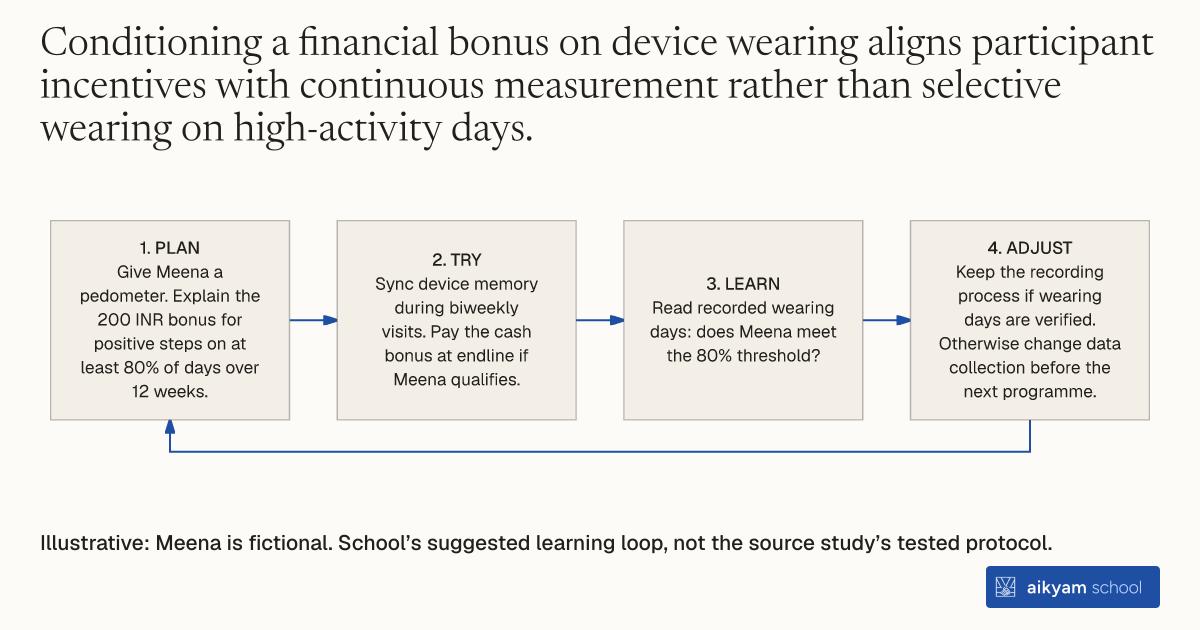
Try, learn and adjust
Check eligibility for the wearing bonus
- Plan: Give Meena a pedometer. Explain the 200 INR bonus for positive steps on at least 80% of days over 12 weeks.
- Try: Sync device memory during biweekly visits. Pay the cash bonus at endline if Meena qualifies.
- Learn: Read recorded wearing days: does Meena meet the 80% threshold?
- Adjust: Keep the recording process if wearing days are verified. Otherwise change data collection before the next programme.
Illustrative: Meena is fictional. School’s suggested learning loop, not the source study’s tested protocol.
See source →School’s suggested, untested loop: observe positive-step days and bonus eligibility, not exercise impact.
How
When to use
Health interventions using wearable tracking devices risk data gaps when participants forget or decline to wear their hardware. Unfavorable or unrewarded tracking days can reduce wearing compliance and distort program evaluations. This method serves health programs monitoring physical activity through daily pedometers or wearable devices.
Offer a lump-sum financial reward conditional on achieving a high threshold of device-wearing days throughout the program.
- Issue tracking pedometers to participants at the start of the intervention period.
- Define device wearing on any given day as recording a positive daily step count greater than zero.
- Establish a baseline wearing threshold requiring valid step data on at least 80 percent of intervention days.
- Offer a completion bonus of 200 INR (approximately 3 USD) in cash paid to participants who achieve the 80 percent wearing threshold over the 12-week program.
- Sync device memory during biweekly field visits to record verified wearing days.
- Disburse the cash bonus at the endline survey evaluation to qualifying participants.
Why it works
High wearing rates reduce selection bias between incentivized and comparison arms.
Example
Surveyors offered a 200 INR cash bonus to adults with diabetes or high blood sugar in Coimbatore, India, for wearing pedometers on at least 80 percent of days. Pedometer wearing rates reached 88 percent in the incentive groups and 85 percent in the monitoring group over the 12-week intervention.
About the study
Participants
2,559 participants with pedometer data across incentive and monitoring groups in Coimbatore, India, with an average age of 49.56 years, 42 percent female, 67 percent diagnosed diabetic, and an average monthly per capita income of 4,465 INR.
Study Design
A field experiment offering a 200 INR cash bonus for wearing pedometers on at least 80 percent of days during a 12-week intervention period, verified through biweekly pedometer data syncs.
Results
The wearing bonus produced high pedometer wearing rates of 88 percent in the incentive groups and 85 percent in the monitoring group, limiting missing data to 15-19 percent of days across arms.