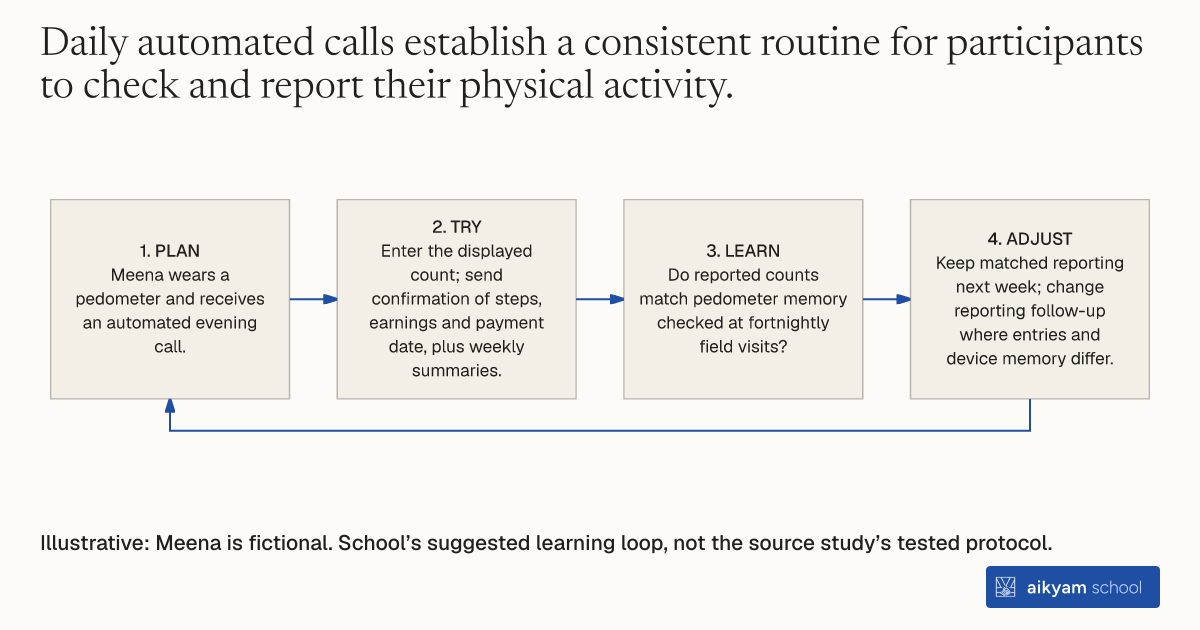
Try, learn and adjust
Check daily step reports and feedback
- Plan: Meena wears a pedometer and receives an automated evening call.
- Try: Enter the displayed count; send confirmation of steps, earnings and payment date, plus weekly summaries.
- Learn: Do reported counts match pedometer memory checked at fortnightly field visits?
- Adjust: Keep matched reporting next week; change reporting follow-up where entries and device memory differ.
Illustrative: Meena is fictional. School’s suggested learning loop, not the source study’s tested protocol.
See source →School’s suggested learning loop, not a tested source procedure. Observe daily entries, device memory and messages during the 12-week intervention; reporting alone does not establish an exercise effect.
How
When to use
Health monitoring programs require daily step data from participants who lack continuous internet connectivity. Manual data collection by field staff is costly and fails to provide rapid feedback to participants. This method serves individuals tracking daily exercise habits in low-resource urban communities.
Deploy an automated daily phone call system to collect daily step counts directly from participants wearing pedometers.
- Program an automated interactive voice response system to call participants every evening at a scheduled time.
- Prompt participants upon answering the call to view their pedometer display and key in the current daily step count using their phone keypad.
- Record the reported step entries automatically in a central program database.
- Issue an immediate text message confirmation following each submission stating the reported steps, payment earned, and payment date.
- Send weekly summary text messages reviewing total compliance and cumulative earnings.
Why it works
Immediate text confirmations provide instant feedback on performance and contractual rewards.
Example
An automated IVR system placed nightly calls to trial participants in Coimbatore, India, throughout a 12-week intervention. Participants maintained high reporting engagement, and incentive feedback sent via SMS helped increase the share of days meeting the 10,000-step target by 20 percentage points.
About the study
Participants
3,192 enrolled participants in Coimbatore, India, with an average age of 49.56 years, 42 percent female, 67 percent diagnosed diabetic, and an average monthly per capita income of 4,465 INR.
Study Design
Participants received daily automated IVR phone calls every evening prompting them to key in pedometer step counts, followed by instant confirmation SMS messages and biweekly field worker visits to sync physical pedometer memory.
Results
Daily automated IVR reporting enabled tracking across 205,732 participant-days during the 12-week intervention, supporting a 20 percentage point increase in daily step-target compliance in incentive groups relative to monitoring.