Try, learn and adjust
Check device use before incentives start
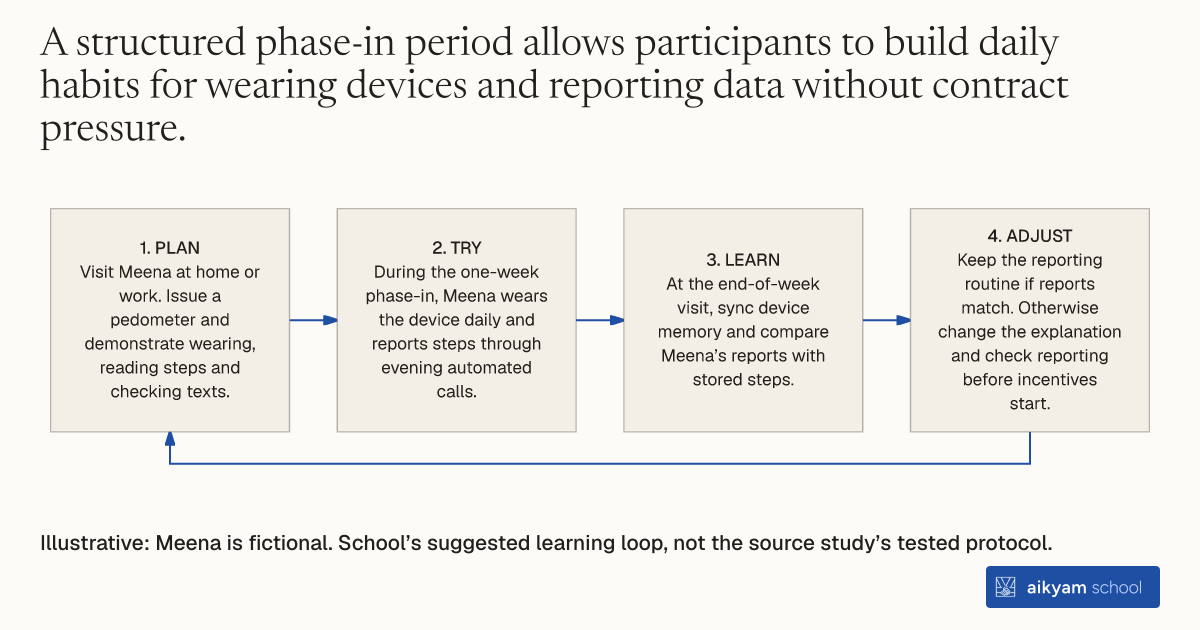
- Plan: Visit Meena at home or work. Issue a pedometer and demonstrate wearing, reading steps and checking texts.
- Try: During the one-week phase-in, Meena wears the device daily and reports steps through evening automated calls.
- Learn: At the end-of-week visit, sync device memory and compare Meena’s reports with stored steps.
- Adjust: Keep the reporting routine if reports match. Otherwise change the explanation and check reporting before incentives start.
Illustrative: Meena is fictional. School’s suggested learning loop, not the source study’s tested protocol.
See source →School’s suggested, untested loop: observe wearing and reporting accuracy during phase-in; this is not clinical evidence.
How
When to use
Health interventions requiring digital tracking need participants to become familiar with hardware and daily reporting procedures before receiving incentive contracts. Unfamiliar technology can lead to compliance failures or measurement errors during main program execution. This method serves adult patients undergoing physical activity tracking in low-resource settings.
Conduct a pre-intervention home visit and a one-week phase-in period to train participants on hardware, reporting systems, and daily tracking routines.
- Visit participants at their homes or workplaces to conduct a baseline survey, deliver lifestyle advice, and issue pedometers.
- Demonstrate how to wear the pedometer on the body, read daily step counts, and check program text messages.
- Instruct participants to wear the pedometer every day during the one-week phase-in period.
- Set up an automated evening phone call system that prompts participants each day to enter their pedometer step count.
- Visit participants at the end of the phase-in week to manually sync pedometer data with the central database and check step reports.
Why it works
Initial in-person demonstrations reduce technology errors before main incentive delivery begins.
Example
Surveyors provided pedometers and hands-on orientation to 3,192 adults with diabetes or high blood sugar in Coimbatore, Tamil Nadu. During the phase-in week, participants averaged 7,004 steps per day and met the 10,000-step target on 25 percent of days.
About the study
Participants
3,192 enrolled participants in Coimbatore, India, with an average age of 49.56 years, 42 percent female, 67 percent diagnosed diabetic, and an average monthly per capita income of 4,465 INR.
Study Design
Participants received pedometers and hands-on instructions during a pre-intervention visit, followed by a one-week unincentivized phase-in period with automated evening step-reporting calls and an end-of-week pedometer sync visit.
Results
Participants recorded an average of 7,004 daily steps during the phase-in period and exceeded 10,000 steps on 25 percent of baseline days.