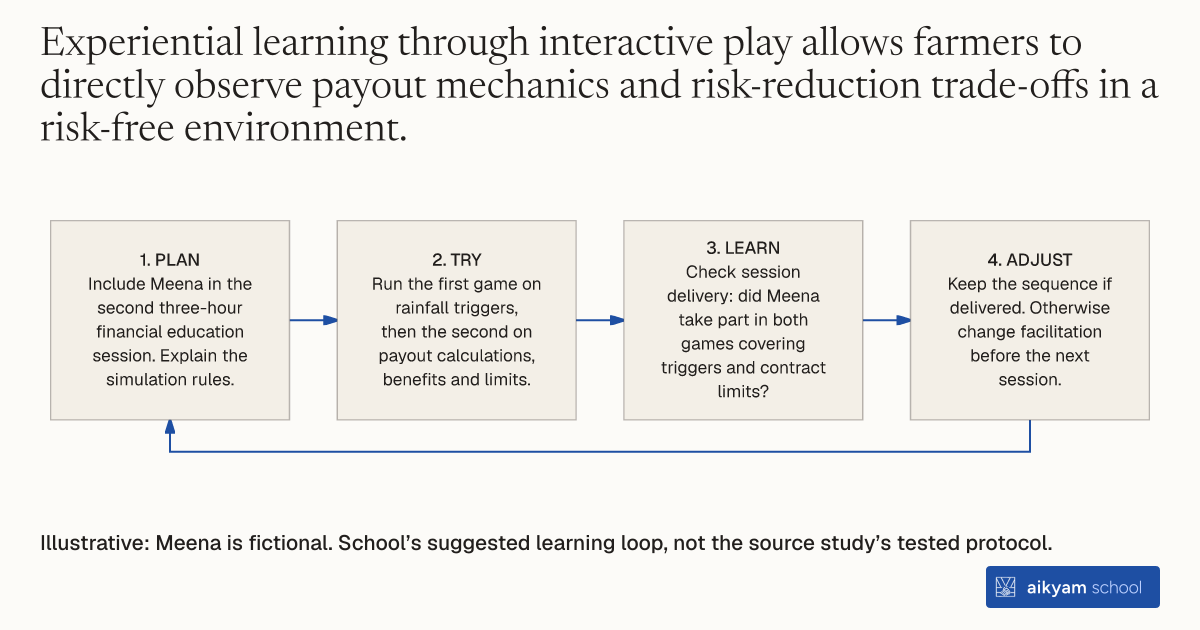
Try, learn and adjust
Check both insurance simulation games are delivered
- Plan: Include Meena in the second three-hour financial education session. Explain the simulation rules.
- Try: Run the first game on rainfall triggers, then the second on payout calculations, benefits and limits.
- Learn: Check session delivery: did Meena take part in both games covering triggers and contract limits?
- Adjust: Keep the sequence if delivered. Otherwise change facilitation before the next session.
Illustrative: Meena is fictional. School’s suggested learning loop, not the source study’s tested protocol.
See source →School’s suggested, untested learning loop. Observe game participation and covered topics. Programme-level take-up effects do not isolate the games’ effects.
How
When to use
Rural farmers often struggle to grasp how index-based weather insurance works in practice through passive lectures alone. Simulation games give participants hands-on experience with how rainfall triggers insurance payouts and highlight both the benefits and limitations of coverage. This approach fits agricultural development projects aiming to demystify complex microinsurance products for smallholder farmers during group educational programs.
Run interactive simulation games during classroom education sessions to demonstrate insurance payout mechanics.
- NGO facilitators convene smallholder farmers during the second three-hour financial education session in target villages.
- Instructors explain game rules simulating seasonal rainfall variations, crop yields, and insurance purchases.
- Farmers play the first simulation game to experience how weather index triggers function during low or excess rainfall years.
- Participants play the second simulation game to observe payout calculations and learn the specific benefits and limitations of rainfall insurance contracts.
Why it works
Experiencing simulated weather events builds practical understanding faster than purely passive instruction.
Example
In coastal Gujarat, India, Development Support Center organized two simulation games for rural cotton and groundnut farmers during the second session of a two-part financial literacy program, contributing to an overall 8.1 percentage point increase in insurance take-up among farmers who completed the training.
About the study
Participants
600 farming households across 15 coastal villages in Gujarat, India, with 300 randomly invited to the program.
Study Design
Randomized controlled trial evaluating a two-session training program where the second session featured two interactive simulation games taught by NGO employees.
Results
Completing the financial education program containing the simulation games increased rainfall insurance purchasing by 8.1 percentage points over the 6.4 percent comparison baseline, while an invitation alone increased purchases by 5.3 percentage points.